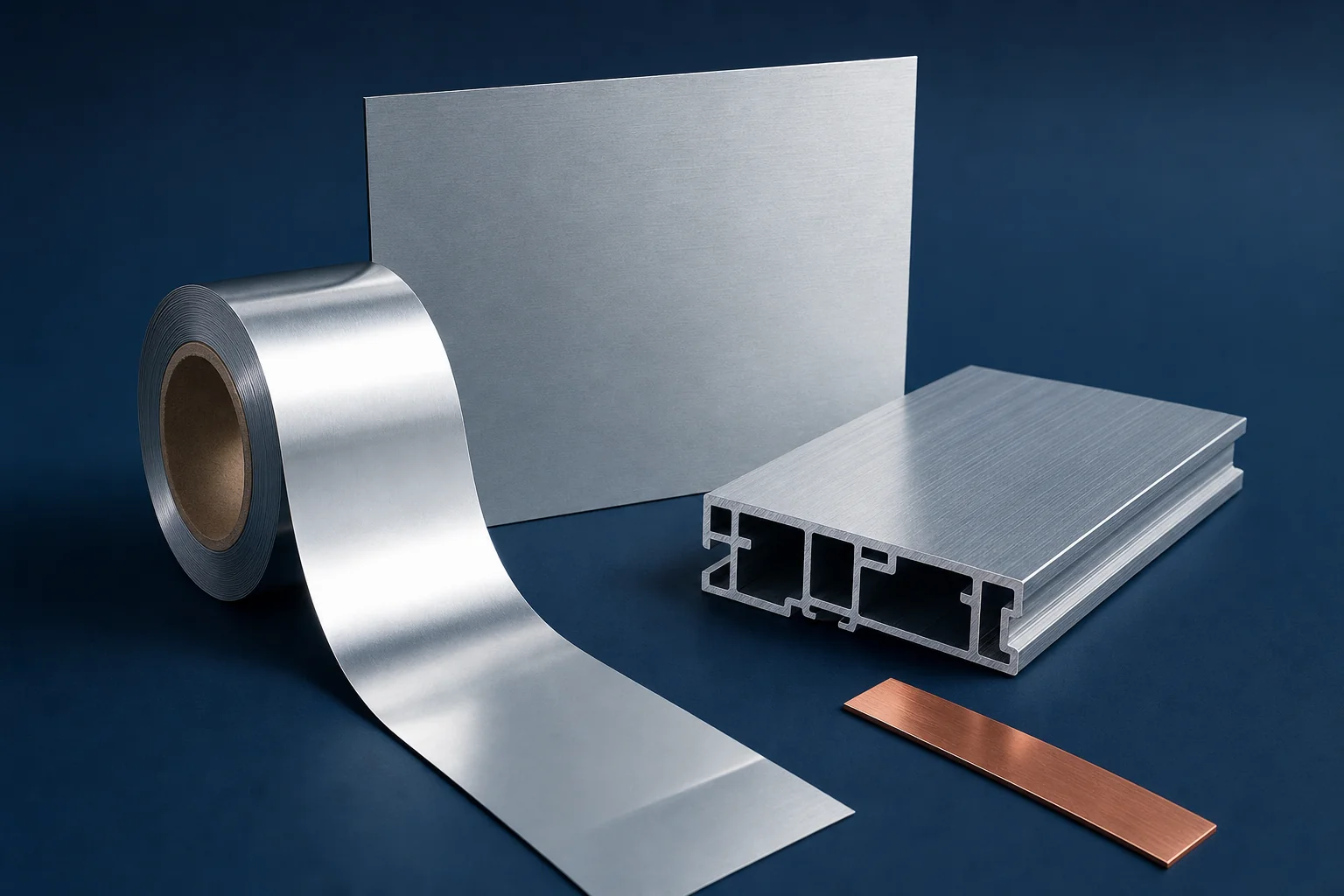
Korea aluminum EV battery supply concentrates in five product forms: cathode foil, pouch film, enclosure sheet, pack extrusions, and busbars. Korea smelts no primary metal, so the value sits in rolling, forming, and qualification discipline built around LG Energy Solution, Samsung SDI, and SK On. For a foreign buyer, the deciding variables are form, allocation, and where your cell plant sits.
Start with the overview of Korea’s aluminum industry and its producers. This piece covers the battery slice: which forms carry the technical risk, which Korean companies make them, and what a foreign EV, battery, or components buyer meets on a first order.
Data current as of September 2026.
Which Aluminum Forms Matter Inside an EV Battery?
Five, and only two of them are exotic.
Cathode foil is the current collector on the positive electrode, aluminum worked to 20 micrometers or thinner, where holding thickness uniform through the pass is the core skill (Dongwon Systems, 2026). Thinner foil leaves more room for active material, which is why cell makers keep pushing gauge down. It carries the longest qualification and the highest scrap sensitivity of the five.
Pouch film wraps the cell in a laminate of protective, adhesive, aluminum, and sealant layers, typically shipped between 100 and 260 micrometers (THE ELEC, 2025). The Korean market has leaned on Japan’s DNP and Resonac, with Youlchon Chemical and SBTL Advanced Materials the two domestic localizers. SBTL signed an investment agreement with Daejeon in March 2026 for a Pyeongchon Industrial Complex plant, ground targeted for the second half of 2026 at more than ten times its Hwaseong capacity (THE ELEC, March 2026). A buyer who cannot get Youlchon allocation has a second name to call.
Enclosure sheet and pack extrusions carry the structural load. Extrusions are the fastest growing aluminum form in a passenger car at a 5.6 percent CAGR to 2030, driven by battery pack housing and sills (Ducker Carlisle for European Aluminium, 2023).
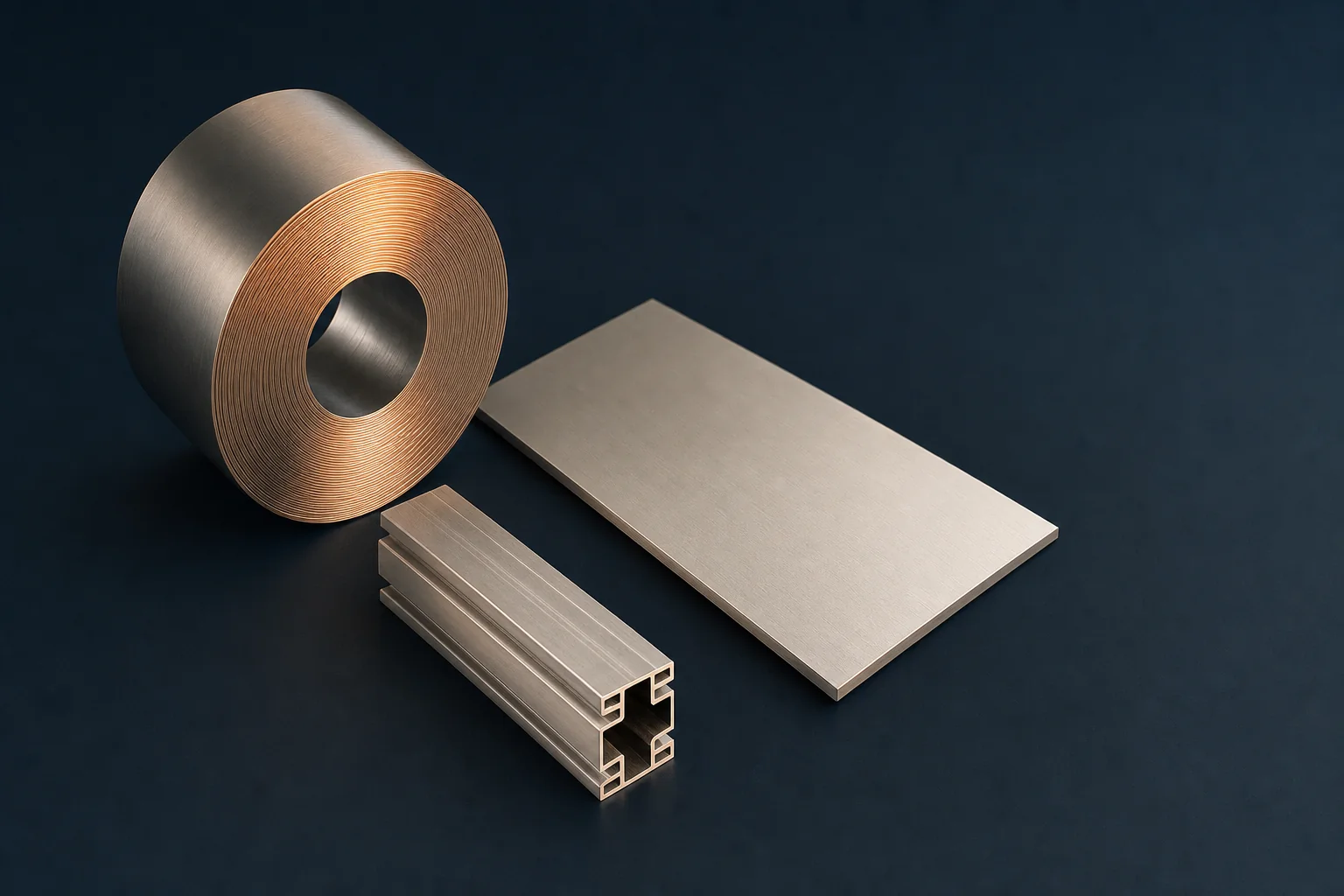
Busbars and module cases are stamped and formed parts bought from component makers rather than mills, and cell cans for cylindrical formats round out the list.
Who Makes Korea’s EV Battery Aluminum?
Cathode foil concentrates in four rollers, and the last published league table is end-2024.
Dongil Aluminium, founded in 1989 and absorbed into KOSPI-listed DI Dongil on August 1, 2025, held 39 percent of the Korean cathode foil market at the end of 2024, ahead of Sam-A Aluminium at 27 percent (thebell via Money Today, August 2025). It supplies all three Korean cell makers (Financial News, August 2025). Its Cheonan plant runs five rolling mills, and a dedicated plant on a 53,554 square meter site in Cheongju High-Tech Valley adds roughly three more, expected to lift output about 60 percent from 2026.
Sam-A Aluminium put 80 billion KRW (about 60 million USD) into its Poseung plant in Pyeongtaek to take cathode foil capacity from 22,000 to 30,000 tons a year and rolling lines from four to six by October 2023. Its customers then covered LG Energy Solution, Samsung SDI, and SK On, alongside a 215.4 billion KRW (about 161 million USD) long-term cathode foil contract with France’s ACC signed in May 2022 and running to 2030 (Electronic Times, December 2022).
Lotte Infracell, the battery materials business separated out of Lotte Aluminium in April 2024, lists cathode foil, cell pouch, and coated cathode foil developed for LFP, all-solid-state, and dry-process cells (Lotte Infracell, 2026). Its Ansan plant rolls the foil. Its 36,000 ton per year plant in Elizabethtown, Kentucky, a 330 billion KRW (about 246 million USD) joint venture with Lotte Chemical, is built and was in commissioning and sample production for North American customers as of July 2026 (Metro Seoul, July 2026). If your cell plant sits in North America, that is the first Korean-owned cathode foil line you can sample from without an import.
Dongwon Systems began cathode foil production at its Asan plant in 2020, holds ISO 9001 and IATF 16949, and supplies foil into IT, power tool, ESS, and xEV cells through Korean battery makers (Dongwon Systems, 2026). It also produces 21700 cylindrical cell cans.
On flat rolled product, Ulsan Aluminum, the Novelis and Kobe Steel joint venture, makes automotive and specialty sheet under IATF 16949, ISO 9001, and ASI certification (Novelis, 2026). For which Korean mills roll what, see the guide to Korean aluminum suppliers of sheet, plate, and coil, and for pack framing and enclosure profiles, sourcing aluminum extrusions from Korea.
Module hardware sits with component specialists. Shinsung ST supplies busbars and battery module cases to LG Energy Solution and SK On, and in April 2025 won its first direct award from a global EV manufacturer, with a Kentucky plant targeted to start ESS component production later that year (Newsis, April 2025). LS EV Korea in Gunpo lists battery module components, high voltage components, power distribution components, and busbar housing assemblies (LS EV Korea, 2026).
Pouch film runs through Youlchon Chemical, the sole supplier of the 183 micrometer film used in LG Energy Solution’s JF2 ESS pouch cell. LG Energy Solution was Youlchon’s largest electronic materials customer in 2025 and accounted for 19.6 percent of Youlchon’s total revenue of 458.3 billion KRW, about 342 million USD (THE ELEC, 2026). Pouch film’s own share is unpublished, but the electronic materials division holding it reached 34.2 percent of revenue in 2025 against 22 percent in 2023, so concentration is rising. Ask for the split if it affects your supply plan.
Why Does the Battery Cluster Change Your Sourcing Position?
The Korean rollers were built for a cell ramp that slowed, and most Korean cathode foil demand still goes to imports. Both facts work in a foreign buyer’s favor.
Korea’s three cell makers ran near half capacity through the first half of 2025. LG Energy Solution reported 51.3 percent average utilization, down from 69.3 percent in 2023, while SK On reported 52.2 percent and Samsung SDI’s overall rate was estimated around 50 percent (Korea Herald, August 2025). The full-year picture confirms the pressure: global EV battery usage reached 1,187 GWh in 2025, up 31.7 percent, while the combined share of LG Energy Solution, SK On, and Samsung SDI fell 3.3 percentage points to 15.4 percent (SNE Research, February 2026).
The second fact is the import gap. As of September 2023, the three Korean cell makers covered about 40 percent of their aluminum cathode foil demand from domestic producers, with the balance imported, largely from China (IB Tomato, September 2023). Korean rollers have been building toward that gap ever since, which is what the Cheongju and Poseung expansions are for.
What Does a Foreign Buyer Actually Run Into?
Two approval tracks, one allocation problem, and a price that is mostly conversion.
Qualification runs on parallel tracks. Supplier system approval, meaning ISO 9001 plus IATF 16949 for automotive work, sits with the roller. Part approval sits with your cell maker or OEM program, and for cathode foil the cell maker runs its own coating and cell build trials on the actual foil lot. The Korean cell makers run that step as a 4M approval, the customer’s final qualification whenever Man, Machine, Material, or Method changes on a qualified part, so it re-triggers when your supplier moves a line or opens a plant. Youlchon Chemical’s Poseung pouch film line entered trial operation in April 2025, took 4M approval from LG Energy Solution in late April 2026, and began mass production that July (THE ELEC, July 2026): a year of trial operation on an already qualified product moved to a new plant. Budget for that whenever a supplier offers capacity from a plant it is not yet qualified on. Neither track starts until the roller commits a trial run at production width. The same sequencing governs Korean extrusion supplier qualification.
Budget the elapsed calendar honestly: one to two months for the supplier system audit and document pack, two to four months to get a trial run scheduled, three to six months for the cell maker’s coating and cell build trials, one to three for its sign-off. Those figures are operator judgment. Twelve to eighteen months to commercial volumes, and the time goes into queueing for mill hours and trial slots, not into the rolling.
Allocation is the harder constraint. Battery foil lines get contracted years out, as the Sam-A agreement with ACC running to 2030 shows, so a new buyer competes with committed tonnage for mill hours. At roughly 50 percent cell utilization the domestic makers under-lift that tonnage, so the roller holds free hours it will not commit long-term, because the customer can call the volume back. Your trial lot runs in a domestic line’s changeover window, which moves when the cell maker’s schedule moves. Ask three questions before you ask for a price: how many mills are dedicated to battery foil, what share of that capacity is contracted, and when the next uncontracted line starts.
The open window is on the coated side. Dongwon Systems showed primer-coated aluminum foil for LFP storage cells at InterBattery 2026 and said it is in supply discussions with major global battery makers, naming US tariffs on Chinese product as the opening (THE ELEC, March 2026).
Price is mostly conversion. Korean cathode foil export prices moved from around 5,000 USD per ton in 2020 to above 6,500 USD per ton in 2022, and cathode foil exports rose from 391 million USD in 2020 to 618 million USD in 2022 (DI Dongil and Korea Customs Service via IB Tomato, September 2023). That is the last published Korean series, so read it for the shape and not the level. The metal line alone has since moved more than those four years did: aluminum traded at 3,362 USD per tonne on September 9, 2026, up 27.9 percent over twelve months, with LME inventories near a 36-year low (Trading Economics, September 2026). Korea imports every ton it rolls, so metal and premium are given and the conversion charge is the only line you negotiate.
A supplier’s stated future capacity is only as firm as its rolling mill order. Korean battery foil rollers buy from a short list of machine builders, with Achenbach of Germany named in both the Dongwon Systems and Dongil Aluminium expansions, and a mill is a multi-year purchase. Ask for the delivery schedule.
Where Does the Tariff and Origin Exposure Sit?
Section 232 is the live cost line, and the rate follows the annex a part is listed in rather than whether anyone calls it an article or a derivative. Since April 6, 2026, 50 percent applies on full customs value to Annex I-A goods, covering HTSUS chapter 72 and most goods in chapters 73, 74, and 76, while Annex I-B derivative articles carry 25 percent (C.H. Robinson, 2026). Country exemptions have all been eliminated since March 2025 (Congressional Research Service, 2025). Cathode foil, enclosure sheet, and extruded pack framing classify inside chapter 76; busbars, module cases, and finished cell cans are often entered as parts or derivatives outside it and can carry a different rate. Classify the part before you price it.
Origin declarations are the second exposure. United States importers report primary and secondary country of smelt and country of most recent cast under CBP guidance effective June 28, 2025, and an unknown filing draws the 200 percent duty applied to Russian aluminum (GHY International, 2025). Korea has no smelter, so make all three declarations a purchase order condition.
Lotte’s Kentucky foil line and Shinsung ST’s Kentucky component plant both followed Korean cell plants into the United States, and Lotte’s is far enough along to sample. If your cell assembly sits in North America or Europe, ask which of a supplier’s plants would ship your part, because the answer changes the duty, the transit, and the audit location. European buyers separately carry the EU Carbon Border Adjustment Mechanism, in its definitive phase since January 1, 2026 (International Carbon Action Partnership, 2026).
How Should a Foreign Buyer Structure the Decision?
Three questions, in order.
Where does the cell or pack plant sit? That decides whether you buy from Korea, from a Korean-owned plant abroad, or from a mix, and it sets your Section 232 and CBAM position before any technical discussion.
Which form carries your technical risk? Cathode foil and pouch film are qualification-heavy and slow to switch. Enclosure sheet and pack extrusions are engineering-heavy but run on published standards. Busbars and module cases are tooling-heavy, so the stamping calendar dominates.
What is your volume against the mill’s floor? No Korean cathode foil roller publishes a minimum, so put the four numbers that define one into the RFQ: minimum tonnage per width and gauge, whether the roller will slit from a master coil or requires full width, master coil weight, and how that floor shifts for a trial lot against a running order. Below whatever comes back, a trading house or service center becomes your counterparty, where the criteria in the guide to finding and vetting a business partner in Korea apply.
Frequently Asked Questions
Who are the main aluminum cathode foil producers in Korea?
Four rollers cover most of it: DI Dongil, Sam-A Aluminium, Lotte Infracell, and Dongwon Systems, with DI Dongil first and Sam-A second on end-2024 share. Customer mapping is only partly public. Dongil is reported to supply all three Korean cell makers (Financial News, August 2025) and Sam-A’s customer list covered all three as of December 2022 (Electronic Times). Lotte Infracell publishes no cell-maker pairing, so ask each roller which cell programs its lines are already qualified on.
Can a foreign company buy battery aluminum directly from a Korean mill?
Yes, once the volume clears the mill’s floor, which arrives as a quote condition rather than a published policy and is set per width and gauge. A trial lot prices worse than a running order. Below the floor a trading house or service center holds the mill relationship, which costs you margin, direct sight of the qualification schedule, and the ability to escalate when a trial slips.
How long does cathode foil qualification take with a Korean supplier?
Twelve to eighteen months to commercial volumes is a fair plan, as operator judgment; no Korean roller publishes a calendar. The gate that decides it is the cell maker’s 4M approval, its final sign-off on any change of Man, Machine, Material, or Method. That is why a supplier’s spare capacity at a second plant does not shorten anything: a new line is a 4M change and requalifies from the start.
Is Korean cathode foil capacity available right now?
More than it was in 2022. Korea’s three cell makers ran near 50 percent utilization in the first half of 2025 (Korea Herald, August 2025), and their combined global share fell to 15.4 percent for the full year (SNE Research, February 2026). Capacity built for a steeper ramp has slack, though contracted tonnage still takes priority on mill hours.
Getting a Read on Korean Battery Aluminum
A sourcing decision at this level turns on program stage, form, and plant location well before it turns on price per kilogram. I work with foreign EV, battery, and components companies scoping Korean cathode foil, enclosure sheet, pack extrusions, and module hardware, including which suppliers fit a given volume and how long qualification really runs. Product-level supply of Korean cathode foil, coil, and sheet in specific alloys is handled by Inquivix Technologies. To discuss a requirement, write to joon@joonklee.com or use the contact page.