The Korea aluminum industry is a downstream processing base, not a primary smelting economy. Korea has no bauxite reserves and no primary smelting capacity, but it is one of Asia’s most capable producers of rolled, extruded, and foil aluminum, with particular strength in battery cathode foil and automotive lightweighting. For foreign buyers, Korea is a source of high-specification downstream products. For foreign suppliers, it is a market for unwrought metal, alloys, and scrap.
This guide covers the industry structure, the major producers, the role of EV battery foil, import dependence and trade mechanics, sourcing practicalities, and what foreign companies entering this market should know.
Korea’s aluminum sector operates within the broader context of the country’s industrial economy. For the wider picture, start with the guide to doing business in Korea.
Data current as of August 2026.
Where Does Korea Sit in the Global Aluminum Value Chain?
Korea’s position in aluminum is downstream: it imports metal and transforms it into high-value products. Korea has no primary smelter, appearing nowhere in the smelter capacity table of the U.S. Geological Survey’s Mineral Commodity Summaries 2026, and imports unwrought metal, meaning ingot, billet, and slab, rather than ore. Total aluminum imports reached approximately 9.13 billion USD in 2025 (UN COMTRADE via Trading Economics, 2026). This import dependence exposes Korean producers to global price volatility and supply disruptions, but it has also pushed the industry to build world-class capabilities in rolling, extrusion, casting, recycling, and fabrication, adding value that commodity metal alone does not provide.
The market structure reflects this downstream orientation. Competition concentrates in alloy production, extrusion, rolling, casting, and fabrication rather than upstream smelting. Market leadership depends on technological differentiation in alloy formulation, proximity to major OEM customers (Hyundai Motor Group, Samsung, LG, SK), quality certifications (IATF 16949 for automotive, AS9100 for aerospace), and the ability to deliver just-in-time supply and technical co-development services.
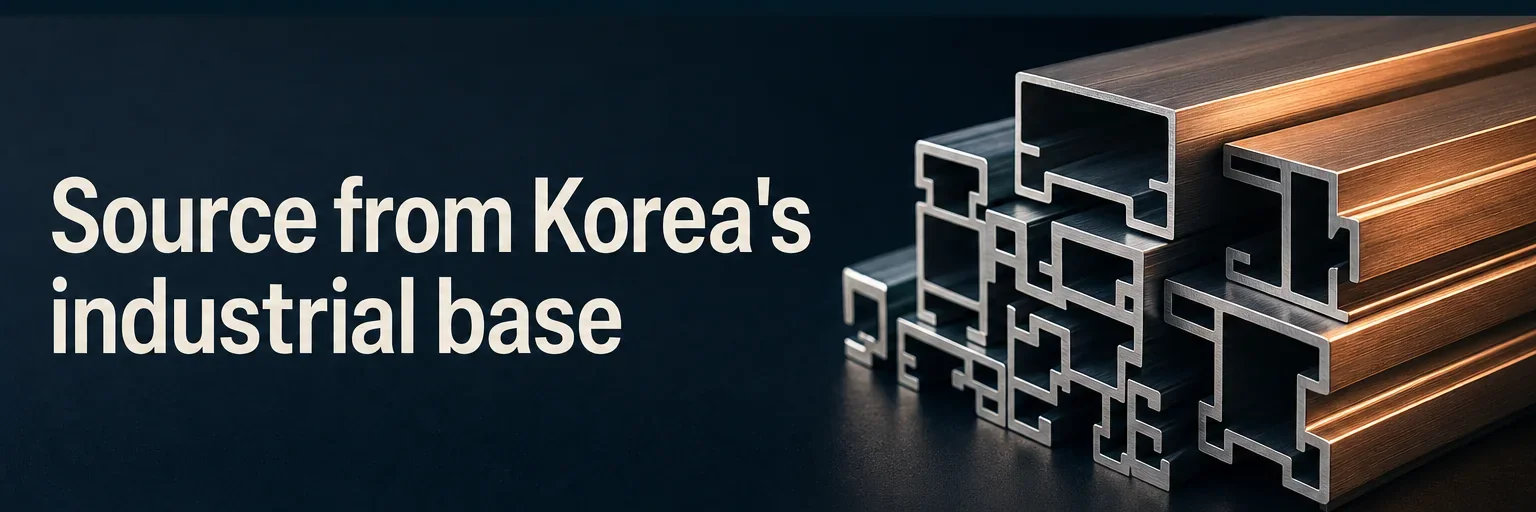
Three product families carry most of the sector’s weight. Flat-rolled products (sheet, plate, coil) feed automotive body panels, beverage cans, appliances, and electronics. For that segment specifically, see the guide to Korean aluminum suppliers of sheet and coil. Extrusions feed construction, rail, and increasingly EV battery enclosures and structural components; for that segment specifically, see the guide to sourcing aluminum extrusions from Korea. Foil feeds packaging and, in its thinnest and highest-purity grades, lithium-ion battery cathode current collectors. For the market’s history and size trend, see Inquivix Technologies’ Korean aluminum market overview.
Who Are Korea’s Major Aluminum Producers?
Korea’s aluminum producer landscape spans a global rolling leader, conglomerate subsidiaries, and specialized mid-sized manufacturers. The players that matter most for foreign buyers depend on what you are sourcing.
Novelis Korea is the largest operation in the country by rolling capacity and the most important for flat-rolled products. A subsidiary of Hindalco Industries (Aditya Birla Group), Novelis operates its Yeongju plant in Gyeongsangbuk-do province, which features a fully integrated system from casting through finishing and houses Asia’s largest aluminum recycling facility, with a beverage can recycling capacity of 340,000 tons per year (Novelis, 2025). Its Yeongju and Ulsan plants have had a combined capacity of roughly one million tons per year since a 2013 expansion (Novelis, 2013). In April 2025, Novelis opened a 65 million USD recycling center at Ulsan Aluminum (a joint venture with Kobe Steel), adding 100,000 tons of annual low-carbon sheet ingot capacity and raising Novelis Korea’s total recycling capacity to approximately 470,000 tons per year (Aluminium Today, April 2025). The Yeongju plant holds full ASI (Aluminium Stewardship Initiative) certification for both Performance Standard and Chain of Custody, which matters for buyers with sustainability procurement requirements. Novelis Korea’s product applications include automotive body sheet, beverage can stock, consumer electronics enclosures, and industrial sheet.
Lotte Aluminium has been a leading packaging materials company in Korea since 1966, producing aluminum foil, flexible packaging, corrugated boxes, and cans across six domestic production facilities plus plants in the United States, Hungary, and Indonesia. Its strategic significance has grown because of its position in EV battery cathode foil. In 2020, Lotte expanded cathode foil production capacity at its Ansan plant to 12,000 tons per year (International Aluminium Journal, 2020). In December 2022, the company signed a 1.04 trillion KRW (795 million USD) long-term supply contract with Choil Aluminum for aluminum strip used as cathode foil raw material (KED Global, December 2022). In August 2022, Lotte Chemical and Lotte Aluminium announced Lotte Aluminium Materials USA, a 238.7 million USD cathode foil plant in Elizabethtown, Kentucky, planned at 36,000 tons per year (Green Car Congress, August 2022). In April 2024, Lotte Aluminium was split into Lotte Infracell, which took the battery materials business, and Lotte Packaging Solutions (Lotte Corporation, 2026). Lotte Infracell signed a long-term foilstock supply agreement with Constellium for its European battery foil operations (Constellium, July 2024). On the packaging side, Lotte Aluminium developed Korea’s first 4.3 micrometer aluminum foil (Lotte Aluminium, 2026).
Choil Aluminum, headquartered in Gyeongsan, Gyeongsangbuk-do, is a KOSPI-listed company and one of the original specialized aluminum semi-fabrication manufacturers in Korea. Choil operates ten continuous casting (CC) machines and produces aluminum strips, coils, sheets, and foils with widths up to 1,750 mm for applications including cathode foils for secondary batteries, automotive components, building materials, heat exchanger fins, electronics parts, and packaging foil (Choil Aluminum; KED Global, 2023). Choil is a critical upstream supplier to cathode foil producers, including Lotte, and received a 30 billion KRW (23.4 million USD) investment from IMM Credit and Solutions in 2023 (KED Global, July 2023).
Sam-A Aluminium, established in 1969, is a leading aluminum foil and processed packaging material manufacturer. It pioneered the world’s first 10 micrometer high-strength aluminum foil and holds 4.5 micrometer ultra-thin foil technology, with 9 micrometer mass production in preparation (Komachine, 2026). Sam-A is a key supplier of LIB (lithium-ion battery) cathode foil to major domestic and international battery manufacturers, producing pouch aluminum foil and tab materials as well.
Hyundai Aluminium (part of the Aluko Group alongside Gogang Aluminium, Alutec, and KPTU) specializes in extrusions for construction, automotive, and electronics applications, including aluminum formwork systems, curtain walls, and consumer electronics components. The Aluko Group is expanding internationally, announcing a 107.7 million USD investment in a U.S. manufacturing facility in Halls, Tennessee, in 2025, focused on EV, solar, and construction applications, alongside a Jackson, Tennessee plant announced in December 2024 (Tennessee Department of Economic and Community Development, 2025).
HAI Materials Korea (HAIMK) is a joint venture between Austria’s Hammerer Aluminium Industries and LS Cable and System. In May 2025, HAIMK opened a 46 million EUR (approximately 50 million USD) fully automated extrusion plant in Gumi, Gyeongsangbuk-do, with a 60-meganewton extrusion line producing complex aluminum components for the Korean market (Aluminium Today, May 2025). AR Aluminum also expanded with a 9,000-ton press in Sacheon (Al Circle, 2026).
SeAH Aerospace & Defense, a subsidiary of SeAH Besteel Holdings, manufactures high-strength aluminum alloy extrusion and forging products for the aerospace industry, supplying materials to Boeing, Airbus, Lockheed Martin, and Korea Aerospace Industries (KAI).
A third tier of established downstream producers serves the domestic construction, electronics, and automotive supply chains and exports selectively. Namsun Aluminum, founded in 1947 and headquartered in Daegu, produces extrusions for windows, doors, curtain walls, and industrial structural materials (Namsun Aluminum, 2026). Daeho AL, also in Daegu, rolls aluminum coil, sheet, and circles for EV, energy storage, display, appliance, and auto parts applications, with stated annual capacity of 78,000 tons of sheet (Daeho AL, 2026). Shinyang Metal, founded in 1976 and based in Ansan, produces extrusions for curtain walls, windows, and automotive parts including EV battery cases, with additional capacity in Vietnam (Shinyang Metal, 2026). For coil, sheet, and foil supply in specific alloys, Inquivix Technologies supplies Korean aluminum coil.
Why Is EV Battery Foil Driving Korean Aluminum Demand?
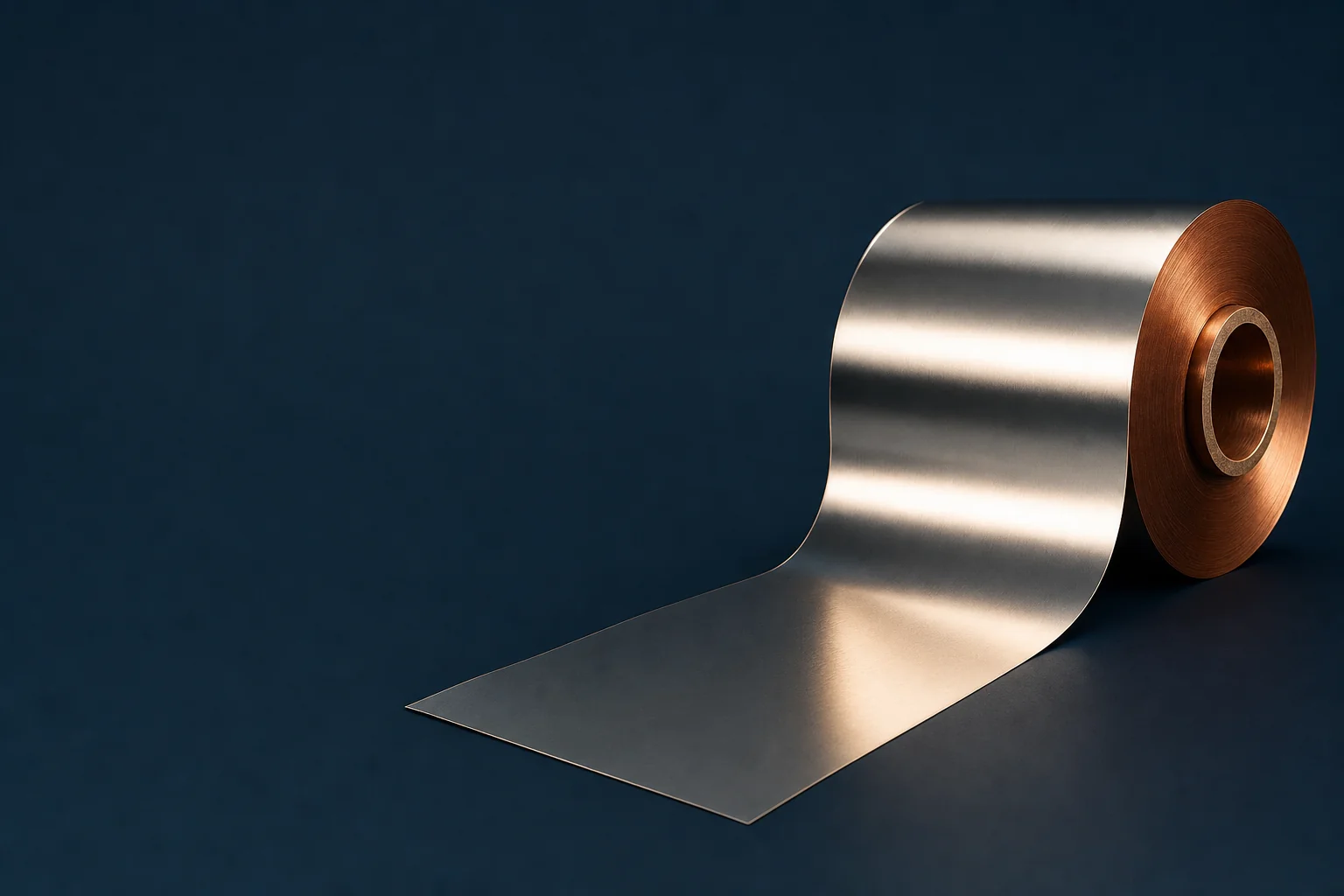
The largest demand growth driver is battery cathode foil. Aluminum foil serves as the cathode current collector in lithium-ion batteries, a component that conducts electrons, manages heat dissipation, and supports the cathode active material that determines battery capacity and voltage. Every EV battery pack requires aluminum cathode foil, and as Korea’s battery champions (LG Energy Solution, Samsung SDI, SK On) scale production capacity, the demand for ultra-thin, high-purity aluminum foil grows with them.
The pull is structural rather than cyclical. Hyundai Motor’s 2030 roadmap targets 3.3 million electrified vehicle sales annually (Hyundai Motor, September 2025), and EVs use substantially more aluminum than conventional vehicles, creating additional demand beyond battery foil in structural and body components, battery enclosures, and thermal management parts. Korean battery makers also operate cell plants in the United States and Europe, which is why Korean foil producers are building capacity abroad (Lotte in Kentucky, Aluko in Tennessee) rather than only exporting from Korea.
This demand is transforming Korean aluminum companies. Lotte’s creation of Lotte Infracell, Sam-A’s push into ultra-thin foil, and Choil’s investment in cathode-grade strip capacity are all responses to the same structural shift. For the buyer-side view of that chain, covering which forms matter inside a pack and who makes them, see the guide to aluminum in Korea’s EV and battery supply chain. For foreign suppliers of primary aluminum, high-purity alloys, or rolling and foil production equipment, Korea’s battery supply chain is a significant and growing customer base.
What Does Korea Import?
Korea’s aluminum import profile reflects its downstream position. The country is a net importer of unwrought aluminum, unwrought alloys, and scrap, and a producer (and in some cases exporter) of rolled products, foil, extrusions, and fabricated articles.
Total aluminum imports reached 9.13 billion USD in 2025 (UN COMTRADE via Trading Economics, 2026). EU imports of aluminum from Korea in 2025 totaled 545 million USD, with the largest categories being plates, sheets, and strips over 2 mm thick (194 million USD), foil (103 million USD), and unwrought aluminum (100 million USD) (UN COMTRADE via Trading Economics, 2026). This trade pattern shows Korea both importing metal and exporting finished aluminum products into global markets.
The import dependence creates opportunities for foreign sellers of aluminum ingot, billet, slab, and wire rod, as well as alloying materials and recycled aluminum scrap. Korean processors need consistent, quality-certified feedstock, and their procurement teams are sophisticated buyers who evaluate price, delivery reliability, alloy specifications, and sustainability certifications. The growth of Novelis Korea’s recycling capacity to 470,000 tons per year (Novelis, 2025) signals the market’s direction: recycled content is increasingly important for Korean producers serving automotive and consumer electronics OEMs with sustainability requirements.
What Tariffs and Trade Rules Apply to Korean Aluminum?
Korea’s trade environment for aluminum involves several layers that foreign buyers and suppliers need to work through.
On the Korean import side, Korea has FTAs with many major trading partners, including the KORUS FTA with the United States, FTAs with the EU and ASEAN, RCEP, and bilateral agreements with China, Australia, and others. For aluminum products entering Korea, these agreements can reduce or eliminate tariffs depending on origin and product classification. Korea’s basic customs tariff on unwrought aluminum and many semi-fabricated products is modest under these agreements, but specific rates depend on HS code classification, and anti-dumping duties apply to certain products from specific origins.
On the export side, Korean aluminum products shipped to the United States face Section 232 tariffs. Section 232 tariffs on aluminum were raised to 50 percent in June 2025, and since April 6, 2026 the rate is 50 percent on goods listed in Annex I-A and 25 percent on Annex I-B derivative articles, with a limited set of metal-intensive industrial and electrical grid equipment derivatives carrying a capped 15 percent rate through December 31, 2027, reverting to 25 percent after that date (GHY International, 2026). A further proclamation signed June 1, 2026 and effective June 8 widened that 15 percent band to agricultural equipment and certain residential HVAC, added an Annex I-C temporary rate structure, lowered the US-origin metal content threshold from 95 to 85 percent, and brought aluminum lithographic plates into derivative coverage (C.H. Robinson, June 2026). Eligibility for the cap is set mainly by product, with one exception that works in Korea’s favor: mobile industrial equipment such as bulldozers and forklifts qualifies for 15 percent only when imported from trade deal partner countries, and South Korea is named on that list (GHY International, 2026). The KORUS FTA does not exempt aluminum from Section 232. Duty, origin, and freight for a Korean shipment are set out in the guide to importing aluminum from Korea. The rate that applies to a given shipment follows the annex the product is listed in rather than an article or derivative label: Annex I-A carries 50 percent and covers chapter 72 and most goods in chapters 73, 74, and 76 including derivatives, Annex I-B derivatives carry 25 percent, and the covered derivatives carry the 15 percent transitional cap (C.H. Robinson, 2026). This is why Korean producers with U.S. customers are building plants in Kentucky and Tennessee rather than relying on exports alone.
The EU’s Carbon Border Adjustment Mechanism (CBAM), which began its transitional phase in October 2023 and entered its definitive phase on January 1, 2026, imposes carbon-based pricing on imported aluminum products (International Carbon Action Partnership, 2026). Korean producers with strong recycling credentials and ASI certifications (like Novelis) hold an advantage under CBAM over producers reliant on carbon-intensive primary smelting, because the embedded emissions they must declare are lower.
Logistically, Korea’s major ports (Busan, Incheon, Ulsan) handle aluminum imports and exports efficiently. Korea’s geographic position provides proximity to China, Japan, and Southeast Asian markets. Domestic logistics infrastructure is highly developed, with most industrial customers located within a few hours of major ports.
How Do You Source Aluminum from Korea?
For foreign companies looking to source aluminum products from Korean producers, several practical considerations shape the process.
Finding suppliers. Start with KOTRA’s buyKOREA platform and its overseas trade centers, plus the Korea Nonferrous Metal Association member list. Industry trade shows such as Korea Metal Week (KINTEX, Goyang) provide direct access to mid-sized producers that do not market internationally. Much ingot and coil trade moves through trading houses (POSCO International, LX International, Samsung C&T) and specialist distributors rather than mill-direct, with pricing following the LME price plus a regional premium. A trading house or distributor is often the practical route for volumes below a mill’s minimum, or for buyers who want one counterparty handling several Korean sources.
Qualification and quality systems. Korean aluminum producers serving automotive, aerospace, and electronics OEMs operate under rigorous quality management systems. Expect IATF 16949 (automotive), AS9100 (aerospace), ISO 9001, and increasingly ASI certification for sustainability. Qualification processes with Korean suppliers typically involve facility audits, sample testing, and trial production runs. For cathode foil and other battery materials, the end-use battery manufacturer runs its own qualification alongside the supplier’s, which adds a second approval track before commercial volumes ship.
Standards and test documentation. Korean mills produce to KS standards (KS D 6701 for aluminum sheet and plate, KS D 6759 for extruded shapes) and will cross-reference to ASTM, EN, or JIS equivalents on request; for products that fall under Korean safety certification, expect KC marks and KTR test reports in the documentation package. Mill test certificates covering chemistry, mechanical properties, and dimensional tolerances are standard, and ASI chain-of-custody or recycled-content documentation is available from the larger producers.
Specifications and technical depth. Korean producers compete on alloy formulation, surface quality, thickness tolerances, and application-specific engineering. If you are sourcing battery foil, the conversation will involve micrometer-level thickness control, surface roughness, tensile strength, and coatability. If you are sourcing automotive sheet, expect discussion of temper, gauge consistency, formability, and surface grade. Korean suppliers are technically capable and expect technically capable counterparts.
Minimum order quantities and lead times. MOQs vary by product and producer, and they are settled in quotation. For rolled coil and sheet the practical floor is one production coil, and mills commonly set that floor at a full container load per alloy and gauge, with the tonnages, the coating minimum, and the leg-by-leg lead time calendar set out in the guide to Korean aluminum suppliers of sheet, plate, and coil. Those figures are operator judgment. Foil and extrusion orders vary by specification, and extrusion minimums follow the die and the press, as the guide to sourcing aluminum extrusions from Korea sets out.
Language and business culture. Procurement discussions with Korean aluminum companies will be conducted partly in English and partly through Korean-language documentation. Technical specifications, contracts, and quality reports may require translation. Korean business relationships develop through consistent communication, face-to-face meetings (especially for initial qualification), and demonstrated technical credibility. The guide to Korean business culture covers these dynamics in depth. For practical structuring of a Korean business relationship, the Korean market entry strategy guide lays out the options.
Payment and trade terms. First orders are typically settled by T/T deposit with the balance paid before shipment, or by sight letter of credit, moving to open account terms once a track record exists. Quotes are typically FOB Busan or Incheon in USD, priced as LME plus a regional premium plus a conversion charge for the product form and alloy. Korean suppliers are accustomed to international export documentation, and the larger producers will quote CIF or DAP on request.
Sustainability and Recycled Aluminum
Sustainability is becoming a differentiator in Korea’s aluminum industry, driven by OEM requirements and global regulatory shifts. Novelis Korea’s 470,000 tons of annual recycling capacity (Novelis, 2025), its ASI certification, and its investment in low-carbon sheet ingot position it as the sustainability leader. The Yeongju Recycling Center has processed over 120 billion aluminum cans since opening in 2012 (Novelis, 2021). The Ulsan recycling center is expected to reduce carbon emissions by 420,000 tons annually (Novelis, April 2025).
For foreign buyers with ESG reporting requirements or sustainability-linked procurement targets, Korean producers can increasingly supply certified low-carbon or recycled-content aluminum. ASI certification and recycled content verification are available from major Korean producers. Product carbon footprint documentation is the scarce piece: a verified figure per alloy and per plant, in English, for a specific coil is what buyers most often cannot obtain. What a Korean mill can actually evidence on embodied carbon, and what that means for a European buyer’s own CBAM filing, is set out in the guide to Korea green aluminum, recycled content and CBAM proof. This is a meaningful advantage for Korean aluminum in markets where CBAM or customer sustainability requirements create a premium for verified low-carbon products.
For foreign suppliers of aluminum scrap, Korea is a growing market. As recycling capacity expands and automotive OEMs demand higher recycled content, Korean processors are actively sourcing quality scrap from international markets.
Frequently Asked Questions
Does Korea produce primary aluminum?
No. Korea has no bauxite reserves and no primary smelting capacity. The industry is entirely downstream: rolling, extrusion, foil production, casting, and fabrication of imported unwrought metal and alloys. This makes Korea a net importer of ingot, billet, and slab and a net producer (and often exporter) of high-value downstream products such as automotive sheet, battery foil, and precision extrusions.
What is driving growth in Korea’s aluminum sector?
The largest structural driver is EV battery cathode foil demand, fueled by the production expansion of Korea’s major battery manufacturers (LG Energy Solution, Samsung SDI, SK On) and Hyundai Motor Group’s electrified vehicle targets. Automotive lightweighting, construction, consumer electronics, and packaging provide steady baseline demand. Recycled and low-carbon metal is a second growth line as OEM and CBAM requirements tighten.
How do I find and qualify Korean aluminum suppliers?
Start by identifying producers whose product capabilities match your specifications, using KOTRA’s buyKOREA platform and overseas trade centers and the Korea Nonferrous Metal Association member list. Korea Metal Week provides direct access. For smaller volumes, trading houses and specialist distributors are the practical route. Expect a qualification process involving facility audits, sample evaluation, and trial production, from a few months for standard products to over a year for battery-grade or aerospace materials.
What tariff considerations apply to Korean aluminum trade?
Section 232 rates follow the tariff annex: 50 percent on Annex I-A goods, which cover chapter 72 and most of chapters 73, 74, and 76 including derivatives, and 25 percent on Annex I-B derivatives. Certain industrial, grid, agricultural, and residential HVAC derivatives are capped at 15 percent through December 31, 2027, with mobile industrial equipment qualifying only from trade deal partners, South Korea among them. The EU’s CBAM separately prices embedded carbon.
Accessing Korea’s Aluminum Industry
Korea’s aluminum industry offers foreign buyers a mature, technically capable supply base for downstream products, from battery cathode foil to automotive sheet to precision extrusions. For foreign suppliers, it is a growing market for unwrought metal, alloys, and recycled aluminum scrap, driven by expanding downstream capacity and the structural shift toward EV battery materials.
Working in this market requires understanding the producer landscape, the technical qualification process, and the trade mechanics that affect cost and competitiveness. For companies looking to source from or supply into Korea’s aluminum sector, a conversation with someone who operates in the Korean industrial ecosystem is worth more than a market report.
Aluminum coil, sheet, and foil supply inquiries are handled by Inquivix Technologies, which sources Korean aluminum in specific alloys and forms for industrial buyers. To discuss Korea aluminum sourcing, supply, or market entry, contact joon@joonklee.com or reach out through the contact page.