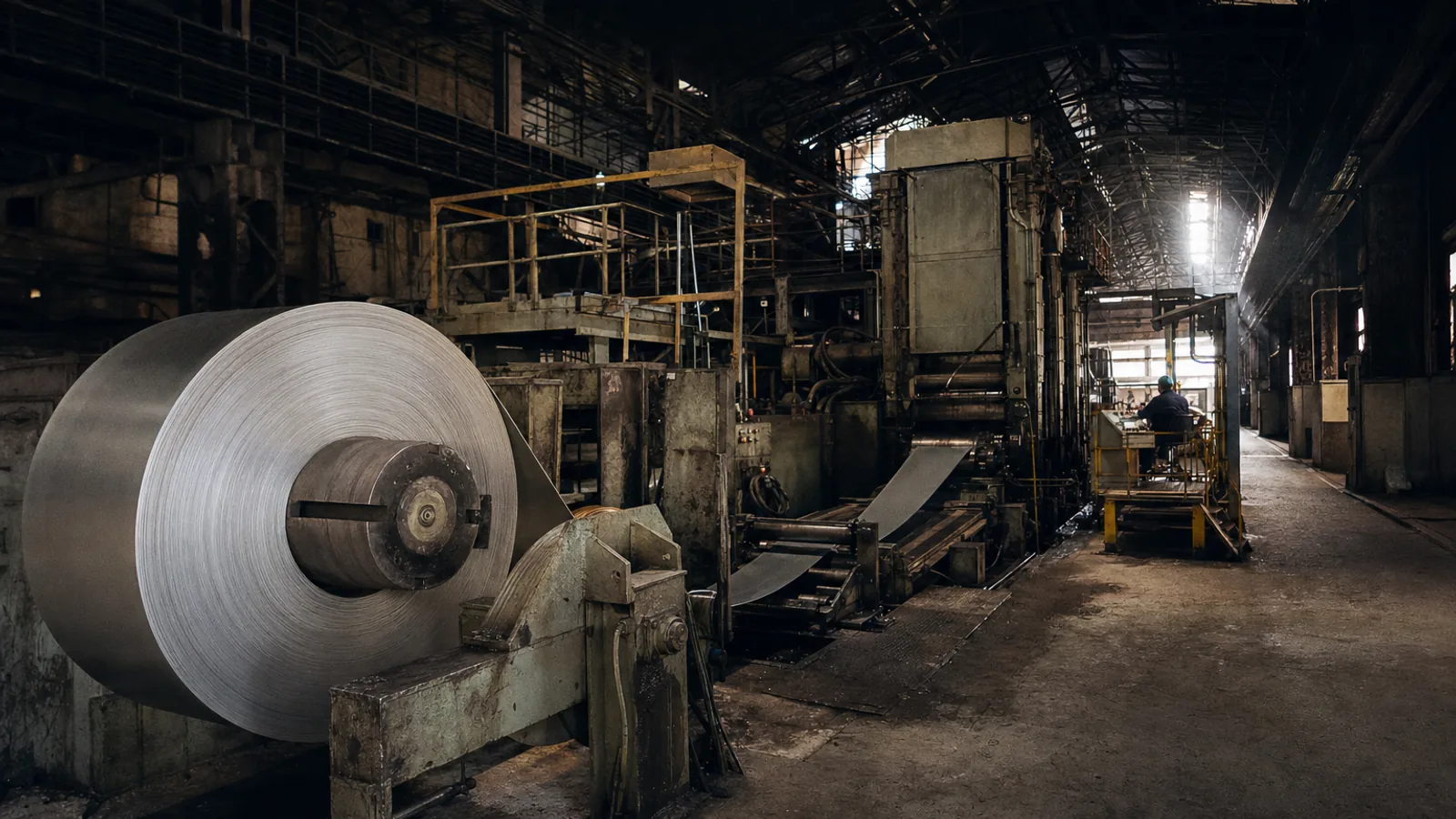
Korea’s aluminum rolling industry is small in plant count and large in output. Three companies roll sheet and strip at scale: Novelis Korea at Yeongju, the Novelis and Kobe Steel joint venture Ulsan Aluminum, and the two domestic mills Choil Aluminum in Gyeongsan and Daeho AL in Daegu. Four companies roll battery cathode foil: Dongil Aluminium (now DI Dongil), SamA Aluminium, Lotte Infracell, and Dongwon Systems. Every one of them starts from imported metal, because Korea has no primary smelter. That is the whole map. The rest of this article is what each plant makes, how big it is, who it sells to, and what the structure means if you are buying from these mills or selling into them.
This piece sits under the broader guide to Korea’s aluminum industry, which covers extrusion, recycling, trade, and policy. Here the subject is rolling only.
Data current as of November 2026. Every figure carries its source and date inline. Where a company does not publish a capacity, none is given.
The map
- Sheet and strip mill
- Battery foil mill
- Cheongju, target H2 2027
- Reference city
| Company | Plant | What it rolls | Scale indicator | Main end markets |
|---|---|---|---|---|
| Novelis Korea (Hindalco) | Yeongju, Gyeongsangbuk-do | Hot and cold rolled sheet and coil, from recycled and primary metal | 461,000 t produced in 2023; upgrade planned to 550,000 t by 2025 (ASI audit report, Dec 2025) | Beverage can stock, automotive sheet, electronics and construction sheet |
| Ulsan Aluminum (Novelis 50 / Kobe Steel 50) | Ulsan | Cold rolled sheet; sheet ingot from the 2025 recycling center | About 300,000 t/yr cold rolled (JV announcement, May 2017); 100,000 t/yr low-carbon sheet ingot (Novelis, Apr 2025) | Can stock, automotive sheet for Kobe Steel’s customers |
| Choil Aluminum (KOSPI 018470) | Gyeongsan, Gyeongsangbuk-do | Continuous-cast strip, coil, sheet | Revenue 305 billion KRW in H1 2026 at an average selling price of about 6.47 million KRW/t (IB Tomato, Oct 2026) | Cathode foil strip for foil mills, automotive and electronics parts, construction, heat exchangers |
| Daeho AL (KOSPI 069460) | Dalseong-gun, Daegu | Cold rolled coil and sheet | Revenue above 100 billion KRW in H1 2025 (SBS Biz, Aug 2025) | Automotive parts, electrical and electronic components, battery and ESS case materials, kitchenware |
| Dongil Aluminium (merged into DI Dongil, Aug 2025; KOSPI 001530) | Cheonan, Chungcheongnam-do; new site in Cheongju | Battery cathode foil, carbon-coated foil | 35,000 t/yr in Q3 2023, rising to 56,000 t/yr after a 220 billion KRW investment in three new mills (inews24, Nov 2023) | LG Energy Solution, Samsung SDI, SK On (Newspim, Nov 2021) |
| SamA Aluminium (KOSPI 006110) | Pyeongtaek, Gyeonggi-do | Battery cathode foil, packaging foil; cold rolled strip for its own use from 2025 | 22,000 t/yr rising to 28,000 to 30,000 t/yr with two new lines, depending on source and date (IB Tomato, Oct 2023) | Battery makers; LG Energy Solution is a related party |
| Lotte Infracell (Lotte Aluminium spin-off) | Ansan, Gyeonggi-do; Hungary; Kentucky JV | Battery cathode foil | 66,000 t/yr across Ansan 12,000 t, Hungary 18,000 t, Kentucky 36,000 t; a second Hungary plant adds 18,000 t in 2027 (IB Tomato, Oct 2026) | Korean and European battery makers |
| Dongwon Systems (KOSPI 014820) | Asan, Chungcheongnam-do | Battery cathode foil, cylindrical battery cans | 14,000 t/yr cathode foil (IB Tomato, Oct 2026); sixth foil line ordered from Achenbach in 2023 (Smart Today, May 2023) | Samsung SDI, LG Energy Solution |
Two things stand out in the table. First, one plant, Yeongju, is larger than every other sheet mill in the country combined. Second, the foil segment has added capacity faster than the battery market has absorbed it, which shapes pricing and lead times in 2026. Both points are developed below.
Sheet and strip
Novelis Korea, Yeongju
Yeongju is an integrated plant: used beverage can recycling, casting, hot rolling, cold rolling, and finishing on one site. The Aluminium Stewardship Initiative’s surveillance audit of December 2025 records 461,000 t produced and 464,000 t sold in 2023, about 740 employees, and a technology upgrade intended to reach 550,000 t by 2025 (ASI Audit Report, Novelis Korea Limited, Certificate 140, Dec 2025). The product groups listed in the same report are can coil, automotive products, and an industrial group covering electronics and construction parts.
The plant is the base of Novelis’s Asian recycling system. Novelis describes Yeongju as Asia’s largest beverage can recycling facility and puts its Korean domestic recycling capacity at approximately 470,000 t per year once the Ulsan center is included (Novelis press release, 15 Apr 2025).
Yeongju is export-oriented. Monthly data for the three Korean sheet producers show Novelis Korea exporting 52,704 t in May 2025 against 15,291 t of domestic sales (Metals Wire, citing producer data, mid-2025). Roughly three tons leave the country for every ton sold inside it.
Ulsan Aluminum, the Kobe Steel joint venture
Novelis built its Korean footprint in two steps. The 400 million USD expansion completed in 2013 raised combined capacity at Yeongju and Ulsan to approximately one million tons of sheet per year (Novelis, 2013; MarkLines, 2013). In 2017 Novelis sold 50 percent of the Ulsan plant to Kobe Steel for 315 million USD, creating Ulsan Aluminum Ltd. The plant was described at the time as a cold rolling facility to be optimized for about 300,000 t per year, with can stock as a core product and automotive sheet supplied to Kobe Steel’s operations in Japan and China, employing around 600 people (Scrap Monster via SMM, May 2017).
In April 2025 Novelis opened a 65 million USD recycling center at Ulsan, fully funded by Novelis, casting 100,000 t per year of low-carbon sheet ingot from can, automotive, and industrial scrap (Novelis press release, 15 Apr 2025). The ingot feeds the rolling mills; it does not add rolling capacity.
For a buyer, the practical difference between the two Novelis sites is the customer book. Yeongju sells can stock and auto sheet into Novelis’s global contracts. Ulsan’s automotive output is largely committed to Kobe Steel’s channel. A new buyer of Korean automotive sheet is therefore negotiating with Novelis’s regional sales organization, and allocation follows global contract priorities rather than proximity.
Choil Aluminum, Gyeongsan
Choil is the domestic strip mill. It casts strip on continuous casters and rolls coil and sheet for Korean converters. Its most important role since 2022 has been as the feedstock supplier to the battery foil mills: in 2022 it signed a 1.04 trillion KRW long-term contract with Lotte Aluminium for cathode foil strip (KED Global, Dec 2022), and Lotte Infracell remained its largest customer in the first half of 2026 at 84.5 billion KRW, 27.7 percent of sales (IB Tomato, 16 Oct 2026).
The same report gives the shape of the business: first-half 2026 revenue of 305 billion KRW, up 19.8 percent year on year, operating profit of 23.1 billion KRW, an operating margin of 7.6 percent, and an average selling price of about 6.47 million KRW per ton, up 23 percent, against an LME average of 3,385 USD per ton and an exchange rate of 1,484 KRW per USD for the half. Choil adjusts its selling price monthly against LME, which the company says cushions the shock of metal price swings (IB Tomato, 16 Oct 2026).
Choil sells almost entirely at home. In May 2025 it shipped 8,131 t domestically and 44 t for export (Metals Wire, mid-2025).
Daeho AL, Daegu
Daeho AL rolls aluminum coil and sheet at Nongong, Dalseong-gun, in Daegu, and is listed on KOSPI. Its materials go into automotive parts, electrical and electronic components, and kitchenware, and the company reports growing shipments of materials for secondary battery cells and energy storage system components. Revenue passed 100 billion KRW in the first half of 2025 (SBS Biz, 8 Aug 2025). In March 2026 the company described a push into high-strength, high-precision materials and battery case materials, and said it is the only domestic producer of prismatic can parts for batteries, with export supply chains in Poland, Hungary, Thailand, and India (Asia Economy, 6 Mar 2026). Monthly sales in May 2025 were 2,178 t domestic and 550 t export (Metals Wire, mid-2025).
Daeho is the smallest of the three sheet producers and the one most directly tied to the Korean auto parts and electronics supply chain. It is the mill a parts maker in Gyeongsang province is most likely to be buying from.
The three producers together
Combined sales of the three sheet producers were 78,898 t in May 2025: 25,600 t domestic and 53,298 t export (Metals Wire, mid-2025). Annualized by me from the May figure, that is in the region of 950,000 t; it is an estimate, not a published number. It is consistent with the one-million-ton figure Novelis gave for its own Korean capacity in 2013. The domestic sheet market that Choil and Daeho serve is a fraction of that, on the order of 25,000 t a month across all three companies. Korea rolls a lot of aluminum; most of it is Novelis metal going abroad.
Battery foil mills
Battery cathode foil is 1xxx-series aluminum rolled to a thickness of roughly one hundredth of a millimeter for the positive current collector in a lithium-ion cell. Korea’s foil mills grew up on packaging and converted to battery foil as LG Energy Solution, Samsung SDI, and SK On scaled. Between 2021 and 2025 all four invested in new rolling capacity at once. Where foil sits among the other battery aluminum forms, from pouch film to busbars, is covered in Korea’s aluminum EV battery supply chain.
Dongil Aluminium (DI Dongil)
Dongil Aluminium, merged into KOSPI-listed DI Dongil on August 1, 2025 (thebell via Money Today, August 2025), was described in November 2023 as the largest domestic maker of aluminum foil for secondary batteries, with 35,000 t of annual capacity as of the third quarter of 2023 and a 220 billion KRW program adding three rolling mills to reach 56,000 t (inews24, 21 Nov 2023). The fifth domestic line, a rolling mill ordered from Achenbach of Germany in May 2021, went into a new plant in Cheonan, Chungcheongnam-do; customers named at the time were LG Energy Solution, Samsung SDI, and SK Innovation (Newspim, 30 Nov 2021). Utilization was 67 percent in the third quarter of 2025 with the investment due to complete in the first half of 2026 (IB Tomato, 12 Dec 2025).
In September 2026 DI Dongil signed with Chungcheongbuk-do and Cheongju for a 110.7 billion KRW carbon-coated aluminum foil plant in the Cheongju Hightech Valley complex, next to an aluminum rolling and coating facility already under construction there, with completion targeted for the second half of 2027. Carbon-coated foil serves LFP batteries and energy storage systems (Asia Economy, 16 Sep 2026). That is the first Korean foil mill to build specifically for the LFP and ESS chemistry rather than the NCM pouch and prismatic cells that drove the first wave.
SamA Aluminium
SamA rolls foil at Pyeongtaek, Gyeonggi-do. In October 2023 its cathode foil capacity was about 22,000 t, rising to between 28,000 and 30,000 t as two new lines started, depending on the source and date (IB Tomato, Oct 2023; see the EV battery article for the 30,000 t figure). The more consequential decision was upstream: a 117 billion KRW investment in aluminum cold rolling equipment to make its own strip. Until then SamA bought strip from Novelis Korea and Choil and imported cheaper Chinese strip; the US Inflation Reduction Act’s sourcing rules pushed it to bring strip in-house and cut the Chinese share. The strip is for captive use only (IB Tomato, 5 Oct 2023). The new equipment entered trial operation in October 2025, and SamA’s utilization was 52 percent in the third quarter of 2025 (IB Tomato, 12 Dec 2025).
Lotte Infracell
Lotte Aluminium expanded cathode foil capacity at Ansan to 12,000 t per year in 2020 and announced a Hungarian plant of about 18,000 t per year for European customers with a 110 billion KRW investment (Asia Economy, 2020). In 2022 it chose Achenbach to equip a 36,000 t per year plant in Elizabethtown, Kentucky, through a joint venture with Lotte Chemical, with production targeted for 2025 (Achenbach press release via AlCircle, 7 Sep 2022). The battery materials business was spun off as Lotte Infracell in 2024. As of October 2026 the group’s cathode foil capacity is given as 66,000 t across Ansan, Hungary, and Kentucky, with a second Hungarian plant adding 18,000 t in 2027 for 84,000 t in total (IB Tomato, 16 Oct 2026). For foilstock, Lotte Infracell signed a long-term supply agreement with Constellium in July 2024 for its European operations (Asia Economy, 24 Jul 2024), alongside the Choil contract at home.
The parent packaging business has carried the cost. Lotte Aluminium posted an operating loss of 58.9 billion KRW in 2024 and a 7 billion KRW operating loss in the first quarter of 2025 (IB Tomato, 12 Dec 2025).
Dongwon Systems
Dongwon Systems, the packaging arm of the Dongwon group, rolls cathode foil and makes cylindrical battery cans at its Asan site, supplying Samsung SDI and LG Energy Solution. In May 2023 it ordered an additional wide rolling mill from Achenbach for 35.1 billion KRW, taking its foil lines from five to six (Smart Today, 4 May 2023). Its cathode foil capacity stands at 14,000 t per year and the company targets 20 percent of revenue from the battery business by 2030 (IB Tomato, 16 Oct 2026).
Utilization is the number that matters in 2026
Add up the domestic figures above (Dongil 56,000 t, SamA 28,000 t, Lotte Ansan 12,000 t, Dongwon 14,000 t) and Korea’s four mills are at or heading toward roughly 110,000 t per year of cathode foil capacity inside the country, plus Lotte’s 54,000 t overseas. Demand has not kept pace. The December 2025 review of the sector put SamA at 52 percent utilization and Dongil at 67 percent, and quoted a metals industry source asking whether any buyer would absorb the added output after the expansions complete (IB Tomato, 12 Dec 2025). Depreciation on the new mills is now running through the income statements.
For a battery maker or a pack assembler buying foil, this is a buyer’s market with qualified capacity to spare. For a supplier selling into these mills, demand for strip, rolling oil, work rolls, and spares will follow utilization, and utilization follows the Korean battery makers’ order books in Europe and North America.
What the structure means for buyers and suppliers
Every ton starts as an import. The government’s non-ferrous supply indicator, compiled from Korea Non-Ferrous Metal Association data, states that all aluminum ingot supplied in Korea is imported, and forecasts aluminum supply to rise 5.5 percent in 2026 (e-나라지표, indicator 1379, 2026). The rolling mills are therefore price takers on metal and compete on conversion, alloy control, surface, and gauge. A foreign supplier of primary or alloy ingot is selling to a sophisticated buyer who prices against LME plus a regional premium and will not pay for a story.
Strip is the bottleneck in the foil chain. Three of the four foil mills did not make their own strip when the battery boom began. Choil built its growth on supplying it; SamA spent 117 billion KRW to stop depending on it; Lotte contracted Constellium in Europe. Anyone selling foilstock, or equipment for making it, should read the chain this way: the foil mills are the customers, Choil is both a competitor and a customer, and Chinese strip is the price benchmark the IRA has made politically expensive.
Prices move monthly. The sheet mills adjust selling prices against LME each month. LME aluminum averaged 3,385 USD per ton in the first half of 2026, up 33.4 percent year on year (IB Tomato, 16 Oct 2026), and the Korea Non-Ferrous Metal Association recorded an April 2026 LME average of 3,600.63 USD per ton against 2,381.25 USD a year earlier (Kyunghyang Shinmun, 2 Jun 2026). Contracts with Korean mills are normally LME-linked with the conversion margin fixed, so the negotiation is about the conversion fee and the premium, not the metal.
The export engine faces a 50 percent tariff. Korea exported 5.03 billion USD of aluminum products in 2024, including 1.02 billion USD of aluminum alloy to the United States. US Section 232 tariffs on steel and aluminum rose from 25 to 50 percent in early June 2025 (Metals Wire, mid-2025). Novelis Korea, which ships about two-thirds of its output abroad, is the plant most exposed; the foil mills’ exposure runs through their customers’ US cell plants rather than through direct shipments. Duty rates, origin rules, and freight for buyers shipping out of Korea are set out in the guide to importing aluminum from Korea.
German mill builders dominate the foil segment. Achenbach supplied Dongil’s fifth line, Dongwon’s sixth, and Lotte’s Kentucky plant. For equipment, automation, rolling oil, roll grinding, and thickness measurement suppliers, the installed base in Korean foil mills is a known quantity, and the next round of spending will be upgrades and coating lines rather than new mills.
How to approach each kind of mill
In my work supplying Korean mills and foil producers through Inquivix Technologies, the conversations differ by mill type.
Novelis Korea buys scrap, primary, and alloying elements through a global procurement organization, and a Korean introduction helps less than a track record with Novelis elsewhere. Sells can stock and automotive sheet under global contracts; small buyers are better served by service centers.
Choil and Daeho buy ingot and scrap in Korea, qualify suppliers plant by plant, and value delivery reliability within the Gyeongsang industrial belt. They sell to Korean converters in tonnage lots with monthly LME pricing, and a foreign buyer needs a Korean counterparty for logistics and language.
The foil mills buy strip, primary for their own casting where they have it, and consumables. They are qualified by the battery makers, so a new foil buyer should expect the mill to ask who the cell customer is before quoting. Their suppliers should expect long qualification and lumpy volumes tied to cell plant ramps.
Sources
- ASI Audit Report, Novelis Korea Limited, Certificate 140 PS Rev 3 (surveillance audit 8 to 11 December 2025). Aluminium Stewardship Initiative, December 2025.
- Novelis Opens Ulsan Aluminum Recycling Center. Novelis, 15 April 2025.
- Novelis completes 400 million USD Korea expansion. MarkLines, 2013.
- Novelis announce strategic joint venture deal with Kobe Steel. SMM, via Scrap Monster, May 2017.
- 조일알미늄, 양극박 증설에 일감 기대…판가 하락은 변수. IB Tomato, 16 October 2026.
- 알루미늄박 투자 끝내고 찾아온 청구서…감가상각 폭탄 현실화. IB Tomato, 12 December 2025.
- (알루미늄의 대변신)③삼아알미늄, 원재료 공급망 투자로 미시장 '겨냥'. IB Tomato, 5 October 2023.
- DI동일, '기업가치 저평가 해소' 국내 1위 2차전지 양극박 업체. inews24, 21 November 2023.
- 동일알루미늄 천안 신공장 and Achenbach rolling mill order. Newspim, 30 November 2021.
- DI동일 청주 탄소코팅 알루미늄박 공장 투자협약. Asia Economy, 16 September 2026.
- 대호에이엘 high-value materials and battery case push. Asia Economy, 6 March 2026.
- [상장기업 돋보기] 올 상반기 매출 1천억 돌파…대호에이엘은 어떤 기업?. SBS Biz, 8 August 2025.
- 동원시스템즈, 2차 전지용 양극박 생산 라인 증설. Smart Today, 4 May 2023.
- Achenbach to supply the first battery foil plant on the American continent (Lotte, Kentucky). Achenbach press release, via AlCircle, 7 September 2022.
- Lotte Aluminum to Build Cathode Foil Production Plant for Secondary Batteries in Hungary. Asia Economy, 25 February 2020.
- Lotte Infracell Signs Long-Term Supply Contract for Cathode Foil Raw Materials with German Constellium. Asia Economy, 24 July 2024.
- Lotte Aluminium and Choil Aluminum 1.04 trillion KRW aluminum strip supply contract. KED Global, 13 December 2022.
- South Korean aluminum flat product sales increase in May, but US tariffs impact exports unevenly. Metals Wire, mid-2025.
- 비철금속 국내 수급현황 (indicator 1379, Korea Non-Ferrous Metal Association data). e-나라지표 (Korean national indicators), 2026.
- Non-ferrous metals and AI data center demand. Kyunghyang Shinmun, 2 June 2026.
Frequently asked questions
Which company is the largest aluminum rolling mill in Korea?
Novelis Korea’s Yeongju plant, with 461,000 t produced in 2023 and an upgrade planned to 550,000 t (ASI audit report, Dec 2025). Including the Ulsan Aluminum joint venture, Novelis’s Korean sheet capacity was approximately one million tons per year after its 2013 expansion (Novelis, 2013).
Who makes battery aluminum foil in Korea?
Four companies: Dongil Aluminium (now DI Dongil), SamA Aluminium, Lotte Infracell, and Dongwon Systems. Dongil was described as the largest domestic producer in 2023 with 35,000 t of capacity rising to 56,000 t (inews24, Nov 2023). Lotte Infracell has the largest footprint including overseas plants, at 66,000 t in 2026 (IB Tomato, Oct 2026).
Does Korea produce primary aluminum?
No. All aluminum ingot supplied in Korea is imported (e-나라지표, indicator 1379, 2026). Korean mills import primary and alloy ingot and recycle scrap, with Novelis Korea operating about 470,000 t per year of recycling capacity (Novelis, Apr 2025). The rolling mills are therefore price takers on metal.
Are Korean foil mills running at full capacity?
No. Reported utilization in the third quarter of 2025 was 52 percent at SamA and 67 percent at Dongil, after a capacity build-out that outran battery demand (IB Tomato, Dec 2025). Depreciation on the new mills is now running through the income statements, and foil buyers face qualified capacity to spare.