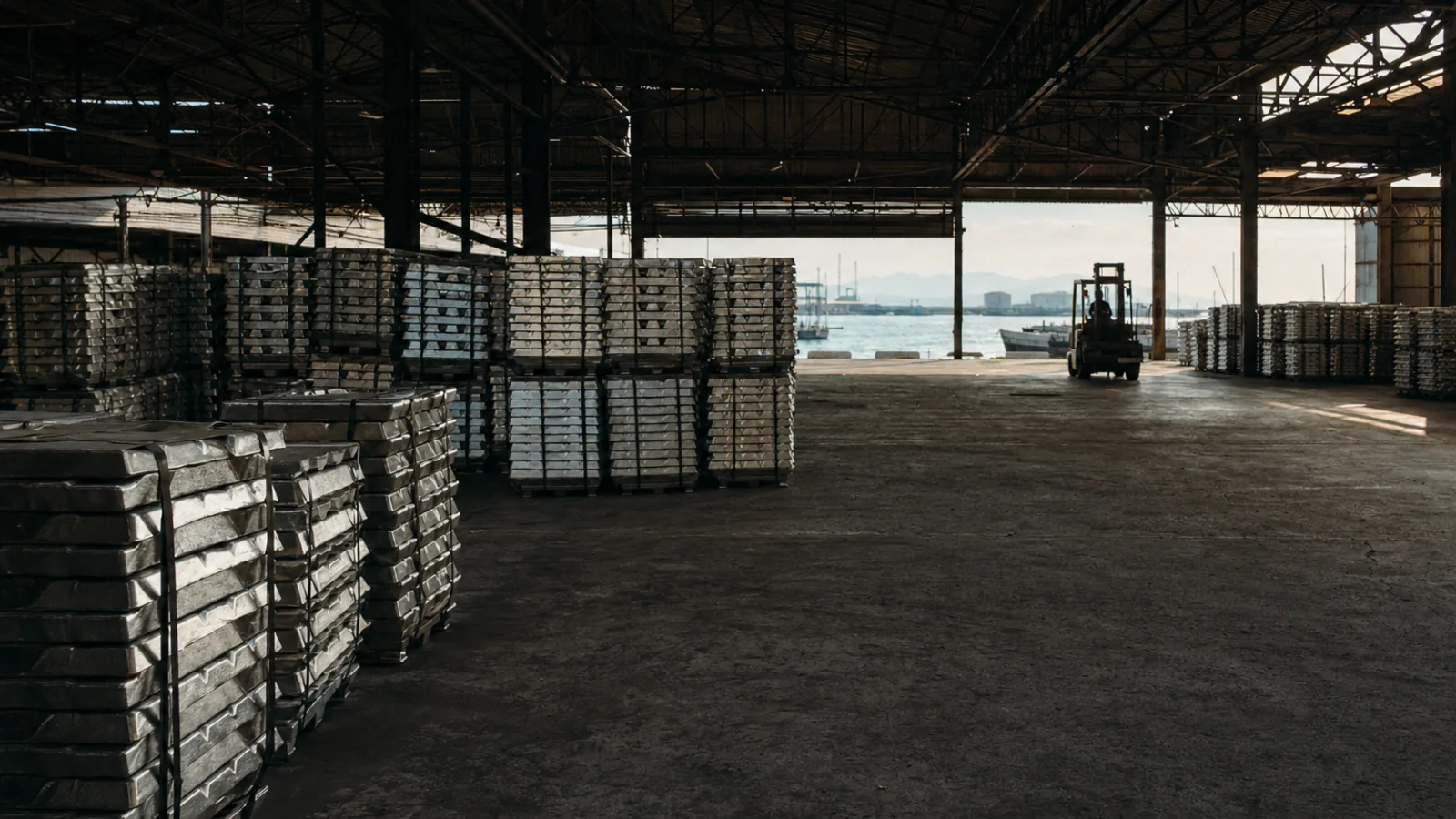
An aluminum ingot landed in Korea is priced in four parts: the London Metal Exchange cash price, a regional premium that Korean buyers negotiate against the Japanese benchmark, import duty of 0 percent under Korea’s trade agreements and 1 percent otherwise, and 10 percent VAT that a registered business recovers. In the first half of 2026 the LME half averaged 3,386 USD per ton and the Asian premium ran between 195 and 395 USD per ton, so a Korean mill was buying metal at roughly 3,600 to 3,800 USD per ton before freight. A US buyer paid 5,792 USD for the same ton. That gap is the single most important number in Korean aluminum this year, and it is why Korean sheet still crosses the Pacific at a 50 percent tariff. The rest of this article shows where each part of the price comes from, what Korea actually paid by origin in 2025, and what happens to the number between the ingot and a rolled coil.
This piece belongs to the Korea aluminum series. The mills doing the buying are mapped in Aluminum Rolling Mills in Korea, and the export side of the tariff story is in US Section 232 Tariffs on Korean Aluminum.
Data current as of November 2026. Every figure carries its source and date inline. Where I have done arithmetic on sourced numbers, the sentence says so.
The price formula
Korean buyers do not pay a Korean aluminum price. There is no domestic smelter and no domestic benchmark; every ton of ingot is imported (e-나라지표, indicator 1379, Korea Non-Ferrous Metal Association data). The contract price is built up:
Landed price per ton = LME cash (monthly average or fixed on a quotation period) + regional premium (CIF Korean port) + duty (0 percent from FTA partners, 1 percent otherwise) + VAT 10 percent (recoverable) + inland handling.
Each term behaves differently. The LME half is a global commodity price that the buyer cannot negotiate. The premium is negotiated and carries the regional supply and demand. Duty and VAT are fixed by law. The practical negotiation between a Korean mill and a supplier of primary metal is therefore about the premium, the quotation period, and payment terms.
The LME half in 2025 and 2026
| Period | LME aluminum cash | Source |
|---|---|---|
| 2025 annual average | 119.284 US cents per pound, about 2,630 USD per ton (my conversion) | USGS Mineral Industry Surveys, Aluminum, Dec 2025 |
| First half 2025 average | 2,538 USD per ton | AlCircle via Mysteel, 26 Aug 2026 |
| 2 January 2026 | 2,986 USD per ton | same |
| April 2026 monthly average | 3,600.63 USD per ton, against 2,381.25 a year earlier | Korea Non-Ferrous Metal Association via Kyunghyang Shinmun, 2 Jun 2026 |
| 2 June 2026, first-half peak | 3,855 USD per ton | AlCircle via Mysteel, 26 Aug 2026 |
| First half 2026 average | 3,386 USD per ton, up 33.4 percent year on year | same |
| 30 June 2026 close | 3,105.50 USD per ton | same |
The first half of 2026 was the strongest aluminum market since 2022. The drivers cited across the trade press were Middle East supply risk around the Strait of Hormuz, where Gulf smelters supply about 8 percent of world primary metal, the European Carbon Border Adjustment Mechanism taking effect on 1 January 2026, and US tariffs pulling metal toward the highest-premium market (AlCircle via Mysteel, 26 Aug 2026). For a Korean mill that prices its own sales monthly against LME, a 33 percent rise in the metal passes straight through to customers; the mill’s conversion margin is what it defends.
The premium: why Korea watches Japan
Korea has no published quarterly premium of its own. The reference for Northeast Asia is the Main Japanese Ports premium, MJP, settled each quarter between Japanese buyers and global producers for P1020 ingot delivered CIF to Japan. Korean CIF offers track it, and the Korean trade press reports the MJP settlement as the Asian price signal.
| Quarter | MJP premium, USD per ton over LME cash | Source |
|---|---|---|
| Q1 2025 | 228 | Platts via AlCircle and Mysteel, 27 Oct 2025 |
| Q2 2025 | 182 | same |
| Q3 2025 | 108 | same |
| Q4 2025 | 86 | same |
| Q1 2026 | 195 | Reuters, reported by Andrea Hotter, Jan 2026 |
| Q2 2026 | 350 to 353 | AlCircle via Mysteel, 26 Aug 2026 |
| Q3 2026 | 395, a decade high | Discovery Alert, 19 Oct 2026 |
| Q4 2026 | 255, down 35 percent | Reuters via TradingView, Oct 2026 |
The series tells the Korean buyer two things. The premium is now a larger share of the price than it was a year ago: at the Q4 2025 settlement it was 86 USD on a 2,800 USD metal price, about 3 percent; at the Q3 2026 settlement it was 395 USD on about 3,400, more than 11 percent. And it moves fast. Sellers opened the Q4 2026 talks at 310 to 325 USD and settled at 255 because Japanese buyers were covered under existing contracts, LME backwardation made holding stock expensive, China’s July unwrought and semis exports rose 18.6 percent year on year to 643,000 t, and new supply was returning from Emirates Global Aluminium’s Al Taweelah restart and Indonesian capacity (Discovery Alert, 19 Oct 2026).
Korea in that same October was described as one of the markets under the most pressure, with offers falling in a disorderly spot market and CRU expecting the price center to drift lower (Discovery Alert, 19 Oct 2026). A Korean mill negotiating 2027 supply in the fourth quarter of 2026 is negotiating from the stronger side of the table for the first time since 2024.
What Korea actually paid, by origin
Korea Customs Service data for 2025 give the average declared value of unwrought aluminum by supplier (AlCircle, 1 Sep 2026):
| Origin | 2025 volume | Average price, USD per ton |
|---|---|---|
| Russia | 483,084 t, up 41 percent, the largest supplier for the first time | 2,744 |
| Australia | 408,657 t | 2,659 |
| China | 394,837 t | 4,424 |
Two things in this table matter to anyone pricing into Korea. First, Russian metal cost more than Australian metal, by 85 USD per ton on average, so Korean mills were buying it for availability and specification rather than for a discount. Second, the Chinese figure is far above the others. The customs data do not break out grades, and Chinese unwrought shipments to Korea include alloyed ingot and higher-value forms, so the 4,424 USD average describes a different product mix, not a premium for the same P1020 ingot. Treat it as a flag to check the HS line, not as a price benchmark.
Set against the LME averages above, the Australian figure of 2,659 USD per ton for the year sits roughly 30 USD above the 2,630 USD LME annual average (declared customs values exclude the premium only when it is invoiced separately, so this comparison is indicative), which is consistent with a year in which the MJP premium fell from 228 to 86 USD and Korean CIF offers followed it down. That is my comparison of two sourced numbers, not a published premium.
Duty and VAT into Korea
Unalloyed unwrought aluminum, HSK 7601.10, carries a basic rate of 1 percent in Korea’s 2026 tariff schedule, a WTO concession rate of 5 percent, and 0 percent under the agreements with Australia, the United States, the European Union, China, India, ASEAN, and RCEP, with no quota-tariff line (Korea Customs Service tariff schedule, UNIPASS, HSK 7601.10.0000, 2026). Since the basic rate applies when it is lower than the WTO rate, metal from an origin without a Korean trade agreement pays 1 percent; that is the rate on Russian ingot. Metal from Australia, India, or Canada enters at 0 percent with a certificate of origin. Alloyed unwrought metal and scrap sit on their own lines and should be confirmed with a broker before quoting.
Import VAT is 10 percent of the customs value plus duty, paid at clearance and recovered by a VAT-registered Korean importer on its return. It is a cash-flow cost rather than a price cost. The government’s 2026 quota tariff plan added an aluminum alloy for EV batteries to the automotive support list but did not change the treatment of primary ingot (Tax Times, 2 Dec 2025).
For a foreign supplier this means Korea is one of the cleanest markets in Asia to sell primary metal into: duty at 0 or 1 percent, no quota, no anti-dumping on P1020, and a buyer base that prices transparently against LME. The competition is on premium, specification, and documentation, and since 2025 on smelt-and-cast origin for any metal the mill will roll for the US market, as the Section 232 article explains.
In won
Korean mills buy in dollars and sell in won. The exchange rate averaged 1,484 KRW per USD in the first half of 2026 (IB Tomato, 16 Oct 2026) and held around 1,500 in May (Newsis, 22 May 2026). At the first-half LME average of 3,386 USD plus a 350 USD premium, a ton of ingot cost about 5.5 million KRW before VAT; that is my arithmetic on the sourced figures. Korean steelmakers, who import most of their raw material, raised second-quarter distribution prices by more than 50,000 KRW per ton to cover the weak won and tariffs (Newsis, 22 May 2026). Aluminum converters face the same exposure with a larger metal share in the product.
From ingot to coil: what conversion adds
Choil Aluminum, the domestic strip mill in Gyeongsan, reported an average selling price of about 6.47 million KRW per ton in the first half of 2026, up 23 percent year on year, and said it adjusts its selling price monthly against LME, which cushions the shock of metal swings (IB Tomato, 16 Oct 2026). At 1,484 KRW per USD that selling price is about 4,360 USD per ton. Against an ingot cost in the region of 3,700 to 3,750 USD (LME 3,386 plus a premium of 350 to 395), the difference of roughly 600 to 650 USD per ton covers casting, rolling, scrap loss, energy, and margin. Those two subtractions are mine; Choil does not publish a conversion fee.
That number is the useful one for a buyer of Korean strip or sheet. The metal is pass-through. The conversion is where a Korean mill competes, and 600 to 650 USD per ton for continuous-cast strip is the figure to hold against quotes from China, Japan, or Europe.
Korea against the other regions
Indicative all-in cost of a ton of primary aluminum, first half 2026:
| Market | LME | Premium | All-in | Source |
|---|---|---|---|---|
| Korea, indicative, MJP-linked | 3,386 | 195 to 395 | about 3,580 to 3,780 | my sum of the figures above |
| Japan, H1 2026 indicative | 3,386 | 195 to 353 | 3,659 | AlCircle via Mysteel, 26 Aug 2026 |
| Europe, Rotterdam duty paid, May 2026 | 3,670 | 595.50 | 4,265.50 | same |
| United States, Midwest, H1 2026 average | 3,386 | 2,406 | 5,792 | same |
The US Midwest premium averaged 109.1 US cents per pound in the first half of 2026, more than two and a half times the first half of 2025, and had become close to half of the delivered cost of metal in the United States (AlCircle via Mysteel, 26 Aug 2026). In October 2026 it was still near 2,312 USD per ton (Discovery Alert, 19 Oct 2026). The USGS puts the 2025 US Midwest market price at 178.187 cents per pound for the year and 220.202 cents in December 2025 (USGS Mineral Industry Surveys, Dec 2025).
This is the arithmetic behind the tariff story. A Korean mill buys metal about 2,000 USD per ton cheaper than a US mill. A 50 percent Section 232 duty on a 4,400 USD coil is 2,200 USD. The two numbers are close enough that Korean sheet remains competitive in the US on price alone, before quality and allocation are considered, which is what the first-half 2025 export data showed: aluminum exports to the US fell 3.4 percent while steel fell 16.3 percent (Maeil Shinmun, 3 Sep 2025).
What this means for buyers and suppliers
From the buyer side of Korean mills, where I work through Inquivix Technologies, three practical points follow.
Quote against the right benchmark. A Korean counterparty will read your offer as LME plus premium. State the quotation period (the LME monthly average of the month of shipment is the common Korean convention), the premium in USD per ton CIF Busan or Incheon, and the Incoterm. An offer expressed as a flat price gets converted back into those terms before anyone replies to it.
The premium is where you win or lose. Korean buyers know the MJP settlement the day it is published. In a quarter like Q4 2026, when MJP fell from 395 to 255, an offer that still carries a 350 USD premium does not get a reply. In a quarter like Q2 2026, when Middle East risk pushed it to 350, a supplier with secured shipping had the upper hand. Watch the Japanese talks; Korea follows within weeks.
Documentation is now part of the price. A ton of primary with a clean smelt-and-cast certificate is worth more to a Korean mill that exports to the US than a ton without one, because only the first can be rolled into US-bound coil without a 200 percent duty at the other end. Suppliers from Australia, the Gulf, India, and Canada that can document origin have an advantage in Korea that did not exist before 2023 and is larger than any premium difference in the table above.
For a buyer of Korean sheet or foil, the same logic runs the other way: ask the mill for its LME basis and its conversion fee separately. A quote that bundles them hides the only number the mill controls.
Frequently asked questions
How is the aluminum price set in Korea?
There is no Korean benchmark. Imported ingot is priced as LME cash plus a regional premium negotiated against the Japanese MJP settlement, with duty at 0 percent under Korea’s trade agreements (1 percent otherwise) and 10 percent import VAT that a registered business recovers. In the first half of 2026 that meant LME at 3,386 USD per ton plus a premium of 195 to 395 USD per ton (AlCircle via Mysteel, 26 Aug 2026; Discovery Alert, 19 Oct 2026).
What is the import duty on aluminum ingot in Korea?
The basic rate on HSK 7601.10 unalloyed unwrought aluminum is 1 percent, the WTO concession rate is 5 percent, and the rate under Korea’s agreements with Australia, the United States, the EU, China, India, ASEAN, and RCEP is 0 percent (Korea Customs Service tariff schedule, UNIPASS, 2026). Ingot from an origin without an agreement, Russia included, pays 1 percent; ingot from an FTA partner with a certificate of origin pays nothing. Alloyed ingot and scrap have their own lines.
Why is aluminum cheaper in Korea than in the United States?
Because the regional premium is different. In the first half of 2026 the US Midwest premium averaged 2,406 USD per ton, driven by Section 232 tariffs, against an Asian premium of 195 to 395 USD per ton. On the same 3,386 USD LME price, a US buyer paid about 5,792 USD per ton all-in and a Korean buyer about 3,600 to 3,800 (AlCircle via Mysteel, 26 Aug 2026).
Where did Korea buy its aluminum in 2025 and at what price?
Russia supplied 483,084 t at an average of 2,744 USD per ton, Australia 408,657 t at 2,659 USD, and China 394,837 t at 4,424 USD, the last reflecting a different product mix rather than a premium for the same grade (Korea Customs Service data via AlCircle, 1 Sep 2026).
Sources
- AlCircle via Mysteel, “EU, Canada and Asia aluminium prices: why a 3,386/t benchmark can cost 5,792/t,” 26 August 2026. https://www.mysteel.net/news/5138322-eu-canada-and-asia-aluminium-prices-why-3-386t-benchmark-can-cost-5-792t-read-how-regional-premiums-reshaped-markets
- AlCircle via Mysteel, “Japan’s aluminum premium collapses: what the Q4 86/t settlement means for Asia,” 27 October 2025. https://www.mysteel.net/news/5102310-japans-aluminum-premium-collapses-what-the-q4-86t-settlement-means-for-asia
- Discovery Alert, “Aluminium premiums slide as Japan’s Q4 settlement falls 35 percent,” 19 October 2026. https://discoveryalert.com/analysis/aluminium-premiums-japan-q4-mjp-settlement-october-2026/
- Reuters via TradingView, “Japan aluminium buyers agree to pay Q4 premiums of 255 per ton,” October 2026. https://www.tradingview.com/news/reuters.com,2026:newsml_L4N4600ET:0-japan-aluminium-buyers-agree-to-pay-q4-premiums-of-255-per-ton/
- Andrea Hotter (Reuters), Q1 2026 MJP settlement at 195 USD per ton, January 2026. https://x.com/AndreaHotter/status/2013632099291476183
- US Geological Survey, Mineral Industry Surveys, Aluminum in December 2025. https://d9-wret.s3.us-west-2.amazonaws.com/assets/palladium/production/s3fs-public/media/files/mis-202512-alumi.pdf
- AlCircle, “Korea’s 483kt of Russian aluminium imports hit record high as sanctions risks deepen,” Korea Customs Service data, 1 September 2026. https://www.alcircle.com/news/koreas-483kt-of-russian-aluminium-imports-hit-record-high-as-sanctions-risks-deepen-121004
- 경향신문, 비철금속 가격과 LME 월평균, 2 June 2026. https://www.khan.co.kr/article/202606021546011
- IB Tomato, “조일알미늄, 양극박 증설에 일감 기대…판가 하락은 변수,” 16 October 2026. https://ibtomato.com/View.aspx?no=19807&type=2
- 뉴시스, “미국 이어 EU도 50% 관세 부과,” 22 May 2026. https://mobile.newsis.com/view/NISX20260521_0003639946
- 세정일보 (Tax Times), “내년도 할당관세·조정관세 확정,” 2 December 2025. https://taxtimes.co.kr/mobile/article.html?no=272644
- Korea Customs Service, UNIPASS tariff schedule, HSK 7601.10.0000, 2026 rates (basic 1 percent, WTO 5 percent, FTA 0 percent); rates are served by form query, entry page: https://unipass.customs.go.kr/clip/index.do
- e-나라지표, 비철금속 국내 수급현황, indicator 1379. https://www.index.go.kr/unify/idx-info.do?idxCd=1379
- 매일신문, “대미수출 12% 급감, 철강·알루미늄 수출 감소,” 3 September 2025. https://www.imaeil.com/page/view/2025090315540693993