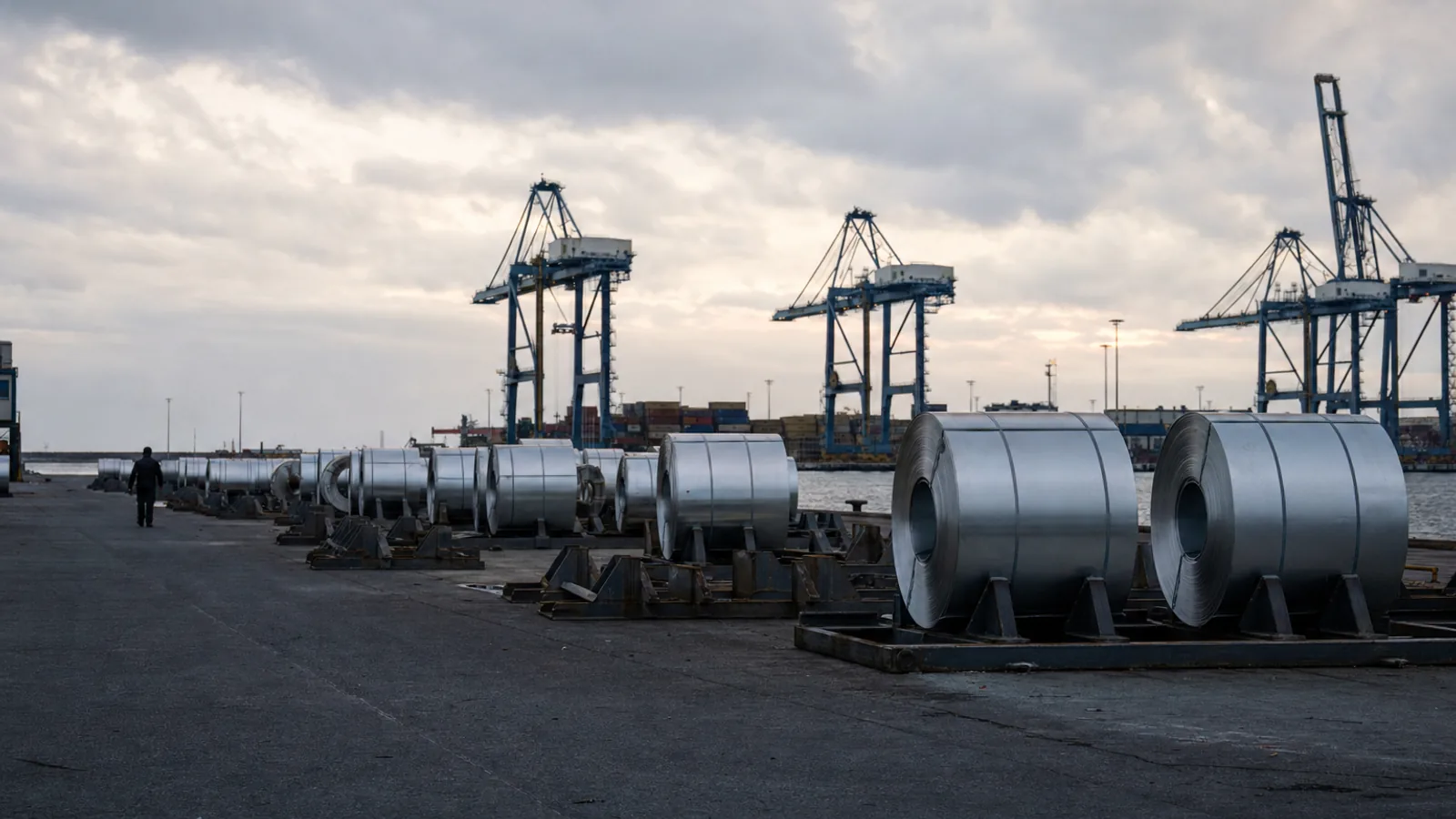
Korean aluminum sheet, plate, foil, and extrusions entering the United States pay a 50 percent Section 232 duty on the full customs value. The rate has applied since June 4, 2025. The Korea-US trade framework of July 2025 and the joint fact sheet of November 14, 2025 cut tariffs on cars and other goods and left steel and aluminum at 50 percent. Two proclamations in April and June 2026 rebuilt the system around derivative products, removed low-metal goods, and opened a 10 percent lane for products made with US-smelted metal, which no Korean mill can use. Korea shipped 1.24 billion USD of aluminum products to the US in 2025, two-thirds of it plate, sheet, and strip. That is the position. The rest of this article is the timeline, the rate that applies to each product type, the exposure in numbers, who is actually paying, and what a buyer or a supplier should do about it.
This piece belongs to the Korea aluminum series. The mills whose exports are at stake are mapped in Aluminum Rolling Mills in Korea: Who Makes What. For tariff treatment of the reverse flow, see Importing Aluminum from Korea.
Data current as of November 2026. Rates and scope change by proclamation; the sources list links every instrument cited. This is a trade explainer, not customs advice. Classification of a specific product is a licensed broker’s job.
How the tariff got to 50 percent
| Date | Action | What changed for Korean aluminum |
|---|---|---|
| June 1, 2018 | Proclamation 9704 takes effect | 10 percent duty on aluminum from nearly all countries. Korea negotiated a steel quota in 2018 and received no aluminum arrangement; its aluminum paid the 10 percent (Sandler, Travis & Rosenberg timeline). |
| February 8, 2020 | Derivatives added | Aluminum derivatives brought into scope. Korea’s exception covered steel derivatives only (STR timeline). |
| April 10, 2023 | Proclamation 10522 | 200 percent duty on Russian aluminum and on any aluminum article containing primary aluminum smelted or cast in Russia (White & Case, Apr 2026). |
| March 12, 2025 | Proclamation 10895 | Rate raised to 25 percent; every country arrangement terminated, Korea’s included; all general approved exclusions ended (STR timeline). |
| June 4, 2025 | Proclamation 10947, signed June 3 | Rate raised to 50 percent (Proclamation 10947; STR timeline; Herald Economy, 31 May 2025). The government held an emergency meeting on the rate on June 2, attended by Novelis Korea, Lotte Aluminium, and Dongil Aluminium (Newdaily, 2 Jun 2025). |
| August 18, 2025 | Inclusions round one | 407 HTSUS subheadings added as steel and aluminum derivatives (STR timeline). |
| November 14, 2025 | Korea-US joint fact sheet | Cars and parts settled at 15 percent; steel, aluminum, and derivatives such as transformers and bolts stay at 50 percent (Financial News, 14 Nov 2025). |
| April 6, 2026 | Proclamation 11021, signed April 2 | Restructured tiers: 50 percent on articles entirely or almost entirely of aluminum, 25 percent on derivatives, both on full customs value; metal-content valuation eliminated; goods under 15 percent metal by weight removed except Chapters 72, 73, 74, and 76; 10 percent for goods made with US-smelted and cast metal; the inclusions process terminated (Proclamation 11021; White & Case, 7 Apr 2026; Perkins Coie, Apr 2026). |
| June 8, 2026 | Proclamation 11032, signed June 1 | US-metal threshold for the 10 percent rate cut from 95 to 85 percent; Korea listed among countries receiving a 15 percent combined minimum on Annex I-C mobile industrial equipment and machinery through December 31, 2027; Annex III fixed industrial machinery and power equipment widened to agricultural equipment and certain residential HVAC; aluminum lithographic plates added at 25 percent (Proclamation 11032; EY Global Tax News, Jun 2026; Thompson Hine, Jun 2026). |
| July 20, 2026 | Proclamation 11045 | Every rate left in place; reduced rates offered only against approved plans for new US smelting capacity (Proclamation 11045; STR timeline). |
| August 6, 2026 | BIS proposal | 14 further derivative articles proposed, including aluminum powder (STR timeline). |
| October 14, 2026 | CBP guidance | Rules for assessing US content under the June proclamation published (STR timeline). |
Two points for a Korean reader. First, Korea never had an aluminum deal to lose. The 2018 quota covered steel. Korean aluminum paid 10 percent for seven years and now pays 50. Second, the November 2025 fact sheet was the moment the industry expected relief and did not get it. A steel industry official told Financial News that day that the US route was effectively closed and described the situation as 막막한 실정 (Financial News, 14 Nov 2025). The Korea Federation of SMEs said the same about aluminum two weeks earlier: the 50 percent rate on steel, aluminum, and derivatives remained and related small companies were still struggling (Aju News, 30 Oct 2025).
What each Korean product pays now
The April 2026 restructuring replaced a rate on metal content with a flat rate on full customs value, in three tiers. The Korea Ministry of Trade, Industry and Energy’s own summary of April 3, 2026 is the clearest statement of how it lands on Korean goods (MOTIE, 3 Apr 2026).
| Product leaving Korea | Section 232 treatment in 2026 | Notes |
|---|---|---|
| Sheet, plate, strip, foil, extrusions, wire, tube: the HTSUS Chapter 76 mill products, headings 7601 and 7604 to 7609 | 50 percent on full customs value (Annex I-A) | The 15 percent weight exclusion does not apply to Chapter 76. KORUS keeps the base Column 1 rate at zero; the 232 duty sits on top (AlCircle, Apr 2026). |
| Fabricated parts and assemblies substantially of aluminum: auto parts, appliance components, heat exchangers, structures | 25 percent on full customs value (Annex I-B) | MOTIE expects some of these to pay more than before, because the base moved from metal content to the whole product (MOTIE, 3 Apr 2026; KITA, 3 Apr 2026). |
| Mobile industrial equipment and machinery on Annex I-C | Combined duty of 15 percent for Korean products through December 31, 2027 (25 percent general rate) | Korea is a listed country. If the Column 1 rate is below 15 percent, the 232 duty makes up the difference; if it is 15 percent or more, the 232 duty is zero (Proclamation 11032, clause 2(b)). |
| Fixed industrial machinery and power equipment on Annex III, including agricultural equipment and certain residential HVAC | Combined duty of 15 percent for all origins through December 31, 2027, then the Annex I-B rate | A temporary rate, not a Korea concession (Proclamations 11021 and 11032). |
| Products with less than 15 percent steel, aluminum, and copper by weight | Out of Section 232 | Cosmetics, food, furniture, and lighting removed; MOTIE puts the removed trade at about 2.3 billion USD, 17 percent of Korea’s derivative exposure (AlCircle, Apr 2026). |
| Any aluminum containing primary metal smelted or cast in Russia | 200 percent | Unchanged since 2023 (White & Case, 7 Apr 2026). An “unknown” smelt or cast declaration is charged at this rate (CBP CSMS 65340246; CSMS 65936615). |
| Products made with 85 percent or more US-smelted and cast aluminum | 10 percent | Not available to Korean mills, which run on imported primary (e-나라지표, indicator 1379). |
The 10 percent lane is worth understanding even though no Korean mill can use it. It is the direction of the policy: the June 2026 proclamation lowered the threshold from 95 to 85 percent, Proclamation 11045 of July 20, 2026 left every rate in place and offered reduced rates only against approved plans for new US smelting capacity, and the October guidance told importers how to prove US content. The administration is building a preference for metal smelted in the United States, where only four smelters operate, down from 24 in 2000 (Wall Street Journal via Gyeongbuk Ilbo, 29 Oct 2026). Korean mills, which import every ton of primary, are on the wrong side of that preference by construction.
Korea’s exposure in numbers
Korea exported 1.24 billion USD of aluminum and aluminum articles (HS 76) to the United States in 2025 (UN Comtrade via Trading Economics, updated Nov 2026). The composition matters more than the total:
| HS 76 product | 2025 exports to the US |
|---|---|
| Plates, sheets and strip over 0.2 mm (7606) | 829.6 million USD |
| Foil (7607) | 159.2 million USD |
| Structures and parts (7610) | 70.3 million USD |
| Other articles of aluminum (7616) | 69.2 million USD |
| Unwrought aluminum (7601) | 34.8 million USD |
| Bars, rods and profiles (7604) | 23.3 million USD |
| Waste and scrap (7602) | 17.9 million USD |
| Tubes and pipes (7608) | 15.7 million USD |
Source: UN Comtrade via Trading Economics, 2025.
Two-thirds of the flow is rolled sheet and plate, which means two-thirds of the exposure sits with the sheet mills, and in practice with one of them. Novelis Korea exported 52,704 t in May 2025 against 15,291 t of domestic sales, more than three tons abroad for every ton at home (Metals Wire, mid-2025). Novelis publishes no destination split for Korea, and part of that volume goes to Asia. Can stock and automotive sheet from Yeongju and Ulsan remain the only Korean products with the volume to produce an 830 million USD line.
Against Korea’s total aluminum exports of 5.03 billion USD in 2024 (Metals Wire, mid-2025), the US took roughly a quarter. For comparison, the US took about 13 percent of Korea’s steel exports in 2024 (Herald Economy, 31 May 2025). Aluminum is more US-dependent than steel, and the figures on the ground were better than that dependence would suggest. In the first half of 2025, with the rate at 25 percent for most of the period, Korean steel exports to the US fell 16.3 percent and aluminum exports fell 3.4 percent (Maeil Shinmun, 3 Sep 2025, citing trade data). The explanation is in the next section.
The damage shows at the small end. In August 2025, 133 companies in steel, aluminum, and auto parts subject to the high tariffs closed; 27 of them were aluminum SMEs (Representative Jung Dong-man, cited by Aju News, 30 Oct 2025). A large mill with a global contract book absorbs a tariff; a 40-person extruder with one US customer does not.
Trade data for 2026 does not yet separate aluminum. Korea’s non-ferrous metal exports in September 2026 were 1.7 billion USD, up 34 percent year on year, in a month when total exports to the US rose 137 percent on AI data center demand (MOTIE, 1 Oct 2026). Aluminum is in that number, as are copper and others. The metal price explains part of the rise: LME aluminum averaged 3,600.63 USD per ton in April 2026 against 2,381.25 USD a year earlier (Korea Non-Ferrous Metal Association via Kyunghyang Shinmun, 2 Jun 2026). Higher dollar values do not mean higher tonnage.
Who is actually paying
A 50 percent tariff on a product the importing country cannot make enough of is paid by the importer. That is the US aluminum position in 2026, and it is why Korean sheet is still crossing the Pacific.
Canada supplied about 70 percent of US aluminum imports in recent years from hydropower smelters in Quebec. The administration removed Canada’s exemption and raised its rate to 50 percent, the same as Korea’s. The US premium over the international benchmark price reached a record high. Ford expects raw material costs including aluminum to rise by up to 2 billion USD this year, and Applied Materials, Allison Transmission, and Ball told investors they are passing aluminum costs to customers. Canada’s aluminum exports to Europe rose 77 percent in January to August 2026 as it diversified away from the US (Wall Street Journal, 27 Oct 2026, via Gyeongbuk Ilbo, 29 Oct 2026).
For Korean mills this is the central fact of the tariff: every major supplier to the US pays the same 50 percent. The only lower lanes are UK-smelted metal at 25 percent, USMCA-qualifying content from Canada and Mexico, and US-smelted metal at 10 percent, and none of those lanes has volume to spare. Korean can stock and automotive sheet compete on the same footing they did before, at a higher landed price that the US customer carries. That is why aluminum exports fell 3.4 percent in the first half of 2025 while steel, where the US has domestic capacity to switch to, fell 16.3 percent.
The rate itself is a known cost. The risk is the 10 percent lane growing as US smelting capacity is rebuilt, and the EU, which raised its own steel safeguard tariff to 50 percent in 2026 with a quota cut from 35 million to 18.3 million tons (Newsis, 22 May 2026), following with aluminum. Neither has happened yet.
How Korean producers have responded
The pattern is the same across the industry: build inside the tariff wall for the US customer, keep the Korean mills for Asia and the domestic battery chain.
- Lotte Infracell’s 36,000 t per year cathode foil plant in Elizabethtown, Kentucky, equipped by Achenbach, was planned to start in 2025 (Achenbach via AlCircle, 7 Sep 2022).
- The Aluko Group, parent of Hyundai Aluminium, announced a 107.7 million USD extrusion plant in Halls, Tennessee, in 2025 for EV, solar, and construction products, after a Jackson, Tennessee plant announced in December 2024 (Tennessee Department of Economic and Community Development, 2025).
- Almex, an extruder supplying a US electric vehicle maker, planned an Alabama subsidiary producing from the first half of 2026 and expected more than half its extrusion sales from the US (MTN, 6 Mar 2025).
- Novelis announced a greenfield recycling and rolling plant in Bay Minette, Alabama, in May 2022, to serve the US can and automotive customers that Korean sheet now reaches through the tariff (Novelis, 11 May 2022).
What none of them did is give up the Korean plants. Foil capacity in Korea kept growing through 2025 and 2026, as the rolling mills article sets out, because the Korean battery makers’ cell plants in Europe and the US are the customers, and those plants buy foil from Korea.
What a buyer or a supplier should do
From the buyer side of the Korean mills, where I work through Inquivix Technologies, three things decide whether a US-bound shipment of Korean aluminum clears cleanly.
Know the tier before you quote. Sheet, coil, foil, and extrusions are 50 percent on full value, with KORUS holding the base rate at zero. A fabricated part is 25 percent on full value, which can be higher than the old metal-content calculation for a part where aluminum was a small share of the price. Mobile industrial equipment and machinery on Annex I-C from Korea is capped at 15 percent combined through 2027. Have the broker confirm the HTSUS line and the annex, then build the landed cost from there.
Trace the primary metal. US entries of aluminum have had to declare the primary country of smelt, the secondary country of smelt, and the country of most recent cast since April 10, 2023, under Proclamation 10522. Since June 28, 2025, an entry that reports any of those as unknown is assessed the 200 percent Russia rate, which applies to the full value of the good (CBP CSMS 65340246, 28 Jun 2025; restated in CSMS 65936615, 15 Aug 2025). No US supplier is more exposed to that rule than Korea. Russia became Korea’s largest source of unwrought aluminum in 2025 for the first time, at 483,084 t, up 41 percent, ahead of Australia at 408,657 t and China at 394,837 t, and Korea has not restricted Russian metal while the EU phases it out by the end of 2026 and the US and UK banned it in April 2024 (Korea Customs Service data via AlCircle, 1 Sep 2026). Japan went the other way, cutting Russian intake from about 512,000 t in 2021 to about 68,000 t in 2025 while Korea’s quadrupled (Korean and Japanese customs data via Global Economic, 22 Oct 2026). A coil rolled from mixed-origin ingot cannot go to the United States at the 50 percent rate. A US-bound order needs the mill to run it on segregated non-Russian primary and to state smelt and cast origin on the mill certificate for that lot, the document brokers advise importers to obtain and keep as a compliance practice (Flexport, 16 Jun 2025).
Watch the 85 percent rule. The 10 percent lane rewards metal smelted and cast in the United States. For a Korean mill it is irrelevant today. For a US buyer deciding between Korean sheet at 50 percent and a domestic mill running US-smelted ingot at a premium, the gap closes as US smelting capacity is added under plans approved through Proclamation 11045. That is a two to five year question, and it is the one to model.
For suppliers of primary aluminum into Korea, the tariff has split the market in two. Russian metal now feeds the domestic and Asian order book at a price close to Australian metal, at an average of 2,744 USD per ton in 2025 against 2,659 USD for Australian metal (Korea Customs Service data via AlCircle, 1 Sep 2026). US-bound production needs documented non-Russian primary, and the mills that export to the US have to buy it. Australian, Middle Eastern, Indian, and Canadian metal with clean smelt-and-cast paperwork has a captive segment in Korea that did not exist before 2023.
Sources
- Proclamation 10947 of June 3, 2025: Adjusting Imports of Aluminum and Steel Into the United States. Federal Register, 2025-06-09.
- Proclamation 11021 of April 2, 2026: Strengthening Actions Taken To Adjust Imports of Aluminum, Steel, and Copper Into the United States. Federal Register (GovInfo), 2026-04-09.
- Proclamation 11032 of June 1, 2026: Further Adjusting the Tariff Regimes for Imports of Aluminum, Steel, and Copper Into the United States. Federal Register, 2026-06-04.
- Proclamation 11045 of July 20, 2026: Further Strengthening Actions Taken To Adjust Imports of Aluminum Into the United States. Federal Register, 2026-07-23.
- Section 232 Tariffs on Steel and Aluminum, action timeline 2018 to October 2026. Sandler, Travis & Rosenberg, 2018 to October 2026.
- United States modifies steel, aluminum, and copper Section 232 tariffs. White & Case, 7 April 2026.
- Restructured and Additional Section 232 Tariffs on Aluminum, Steel, and Copper. Perkins Coie, April 2026.
- US issues proclamation further adjusting Section 232 tariff regimes for aluminum, steel and copper. EY Global Tax News, June 2026.
- President Trump Modifies Section 232 Tariffs on Aluminum, Copper and Steel Imports. Thompson Hine SmarTrade, June 2026.
- 미국, 철강·알루미늄·구리 232조 관세 개편. 산업통상자원부 (MOTIE), 3 April 2026.
- 美, 철강·알루미늄·구리 232조 관세조치 조정. 한국무역협회 (KITA) 국제무역통상연구원, 3 April 2026.
- Korean aluminium, steel, copper exporters gain relief as US revises tariff regime. AlCircle, April 2026.
- 철강업계, 50% 관세 유지에 한숨.. 대미 수출 어쩌나 [한미 팩트시트 발표]. 파이낸셜뉴스, 14 November 2025.
- 철강·알루미늄 中企 '수출 여전히 어려워... 보완책 필요'. 아주경제, 30 October 2025.
- 대미수출 12% 급감, 철강·알루미늄 수출 감소, 피해 확산 불가피. 매일신문, 3 September 2025.
- 트럼프, 철강·알루미늄에 또 관세폭탄, '관세 50%' 韓 영향은?. 헤럴드경제, 31 May 2025.
- 철강·알루미늄 50% 관세 긴급회의. 뉴데일리경제, 2 June 2025.
- South Korea exports of aluminum to the United States (UN Comtrade data). Trading Economics, updated November 2026.
- South Korean aluminum flat product sales increase in May, but US tariffs impact exports unevenly. Metals Wire, mid-2025.
- 2026년 9월 수출입 동향. 산업통상부, 1 October 2026.
- 비철금속 수출 및 LME 가격. 경향신문, 2 June 2026.
- 캐나다산에 50% 관세…美 알루미늄값 뛰고 제조업 '부메랑' (citing the Wall Street Journal). 경북일보, 29 October 2026.
- 미국 이어 EU도 50% 관세 부과. 뉴시스, 22 May 2026.
- 작년 4분기 미국향 알루미늄 수출 50%나 급증. 머니투데이방송 (MTN), 6 March 2025.
- Achenbach to supply the first battery foil plant on the American continent (Lotte, Kentucky). Achenbach press release, via AlCircle, 7 September 2022.
- ALUKO Group to Establish Second U.S. Manufacturing Facility in Lauderdale County. Tennessee Department of Economic and Community Development, 17 December 2025.
- CSMS # 65340246: GUIDANCE: Section 232 Aluminum Import Instructions for Reporting Unknown for the Country of Smelt and Cast. U.S. Customs and Border Protection, 13 June 2025, effective 28 June 2025.
- CSMS # 65936615: GUIDANCE: Section 232 Additional Aluminum Derivative Tariff Inclusion Products. U.S. Customs and Border Protection, 15 August 2025.
- Korea's 483kt of Russian aluminium imports hit record high as sanctions risks deepen. AlCircle, 1 September 2026.
- 日 90% 털어낸 러시아 알루미늄…韓 4배 폭증해 48만t 삼켰다. 글로벌이코노믹 (Global Economic), 22 October 2026.
- CBP's Latest Guidance on Reporting Country of Smelt and Cast for Section 232 Aluminum Tariffs. Flexport, 16 June 2025.
- Novelis to Build $2.5 Billion Low-Carbon Aluminum Recycling and Rolling Plant. Novelis, 11 May 2022.
- 비철금속 국내 수급현황 (indicator 1379). e-나라지표 (Korean national indicators), 2026.
Frequently asked questions
What is the US tariff on aluminum from South Korea in 2026?
Fifty percent for the aluminum mill products of HTSUS Chapter 76 since June 4, 2025, assessed on full customs value since April 2026. Fabricated derivatives substantially of aluminum pay 25 percent. Annex I-C mobile industrial equipment and machinery from Korea, and Annex III fixed industrial machinery and power equipment from any origin, carry a combined 15 percent through 2027. The KORUS FTA keeps the base rate at zero; the Section 232 duty is added on top.
Did the Korea-US trade deal reduce the aluminum tariff?
No. The July 2025 framework and the November 14, 2025 joint fact sheet set cars and parts at 15 percent and cut timber and some derivatives, and left steel, aluminum, and their derivatives at 50 percent (Financial News, 14 Nov 2025).
How much aluminum does Korea export to the United States?
1.24 billion USD in 2025, of which 829.6 million USD was plates, sheets, and strip and 159.2 million USD was foil (UN Comtrade via Trading Economics). Against Korea’s 5.03 billion USD of total aluminum exports in 2024, the US took roughly a quarter.
Why did Korean aluminum exports to the US fall less than steel?
Because the US cannot replace imported aluminum. Four US smelters remain, Canada supplies about 70 percent of US imports and pays the same 50 percent, and the US premium is at a record high, so the tariff is being paid by US buyers. In the first half of 2025 Korean steel exports to the US fell 16.3 percent and aluminum fell 3.4 percent (Maeil Shinmun, 3 Sep 2025; Wall Street Journal via Gyeongbuk Ilbo, 29 Oct 2026).